West of Venice, between the Giudecca and Fusina, a small island covered in trees hides the remains of one of the lagoon’s most influential religious communities. San Giorgio in Alga once welcomed future church leaders, including the man who would become Pope Eugene IV and Saint Lorenzo Giustiniani, Venice’s first patriarch. Later it became a powder magazine, a military outpost and finally an abandoned island.
The history of San Giorgio in Alga is a story of how a seemingly remote place influenced religious reform far beyond Venice—and of what happens when centuries of architecture are left exposed to time and vegetation.
Where is San Giorgio in Alga?
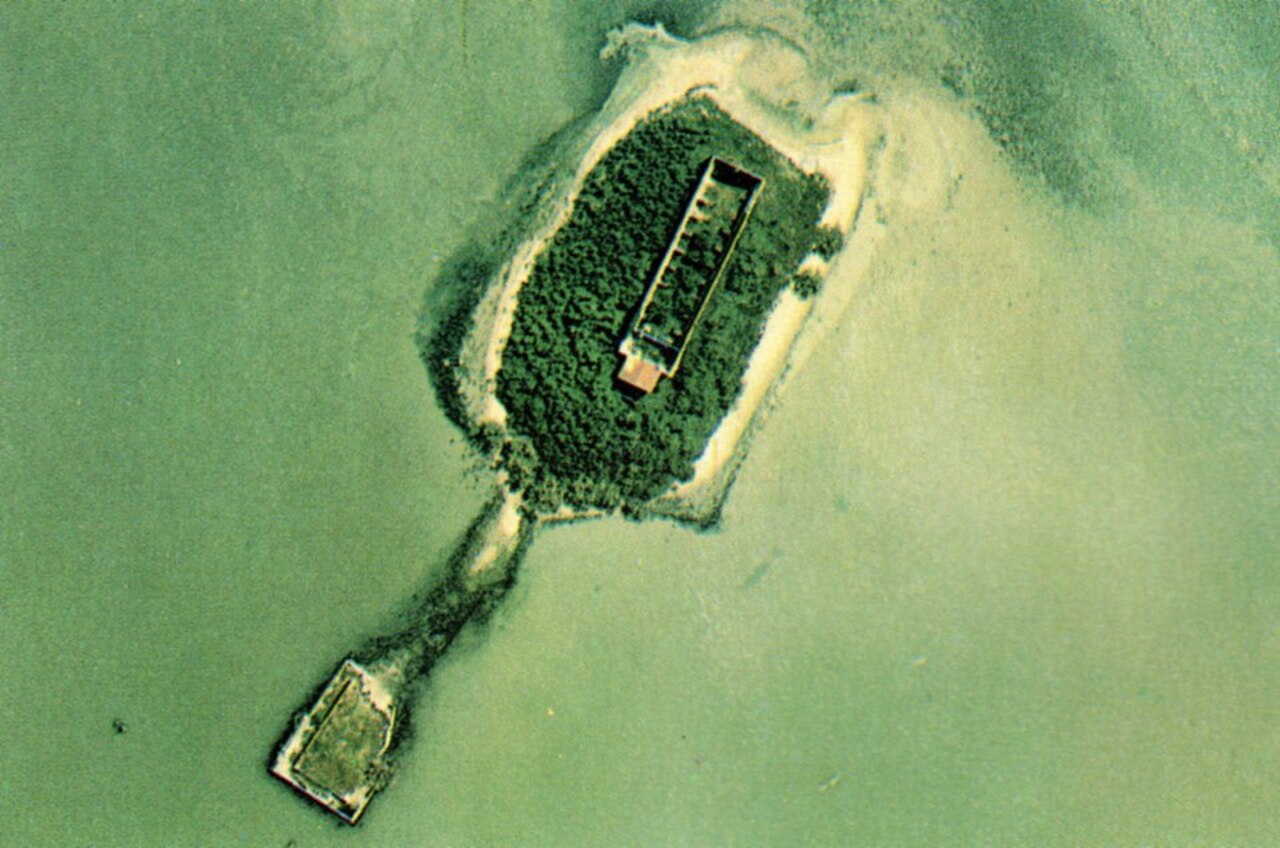
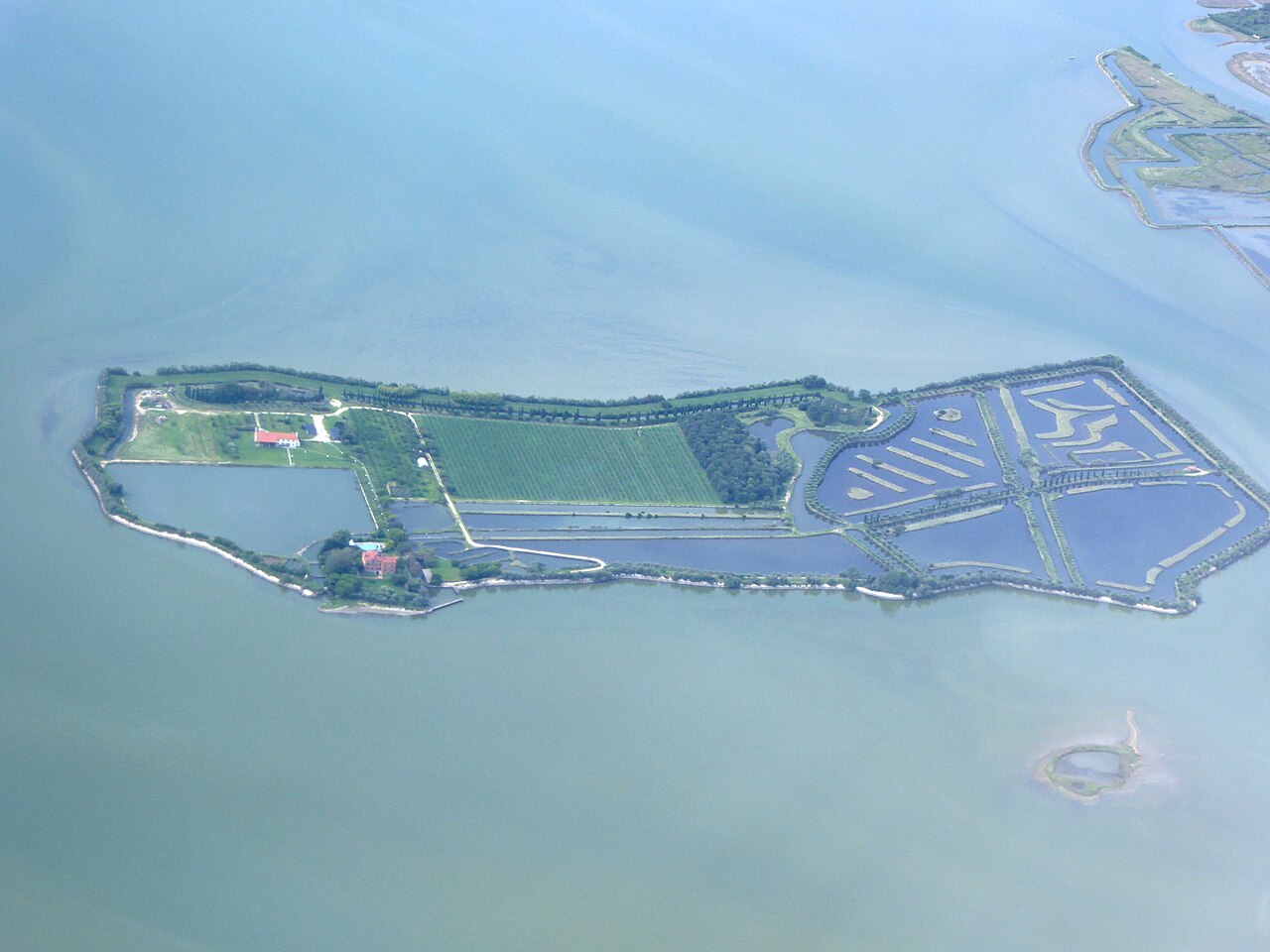
San Giorgio in Alga lies in the western Venetian Lagoon, roughly between the western end of the Giudecca and the mainland at Fusina, close to the water routes towards Porto Marghera. It covers approximately 1.5 hectares: far smaller than San Giorgio Maggiore, the famous island opposite St Mark’s Square.
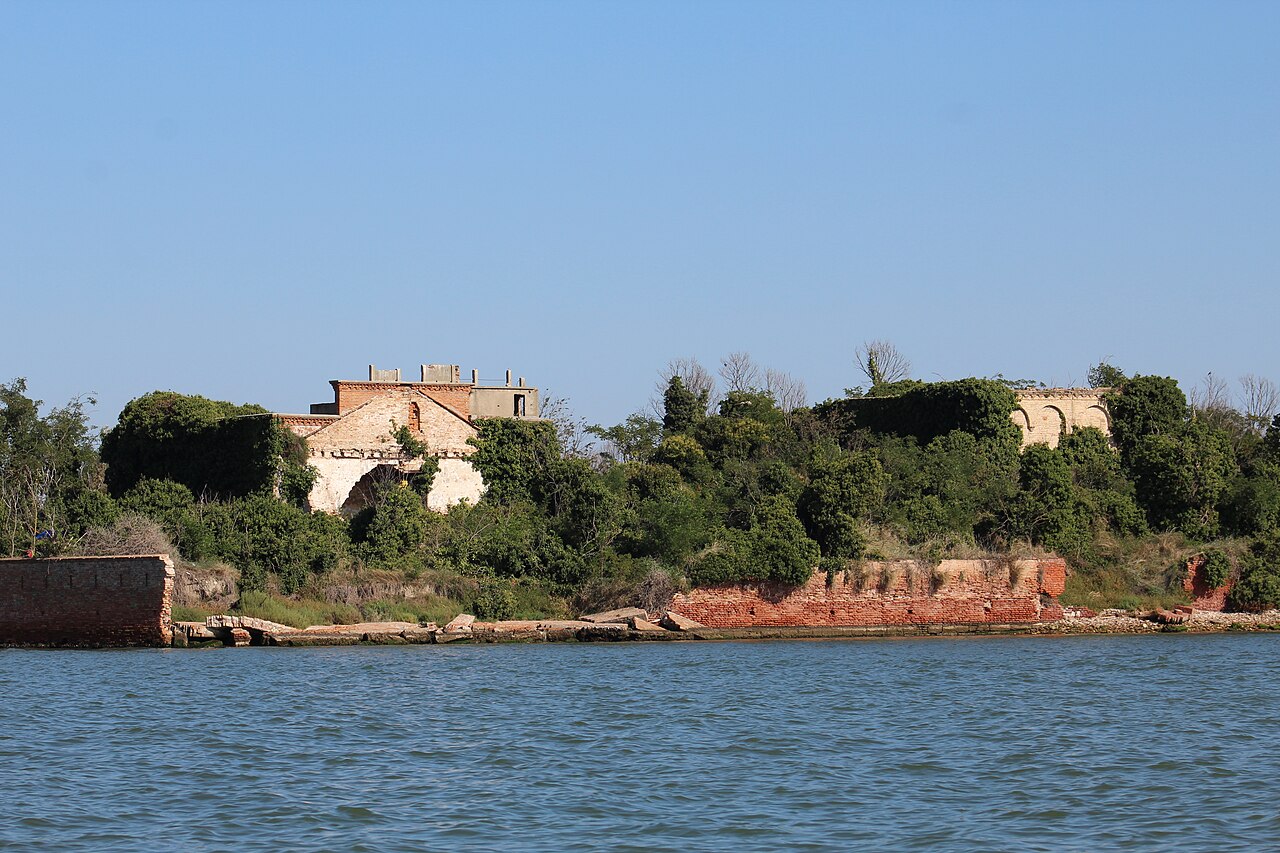
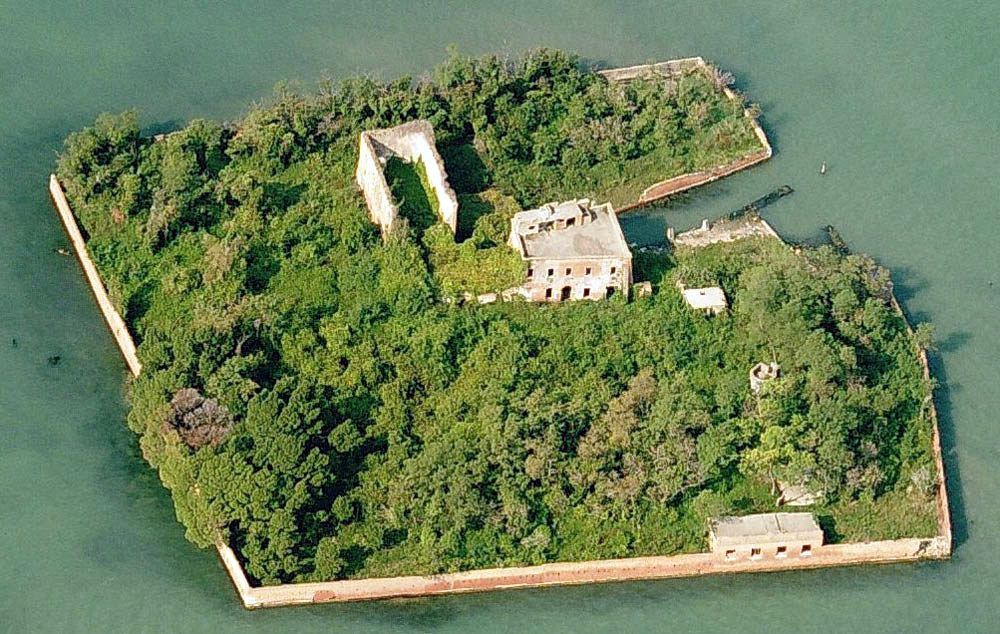
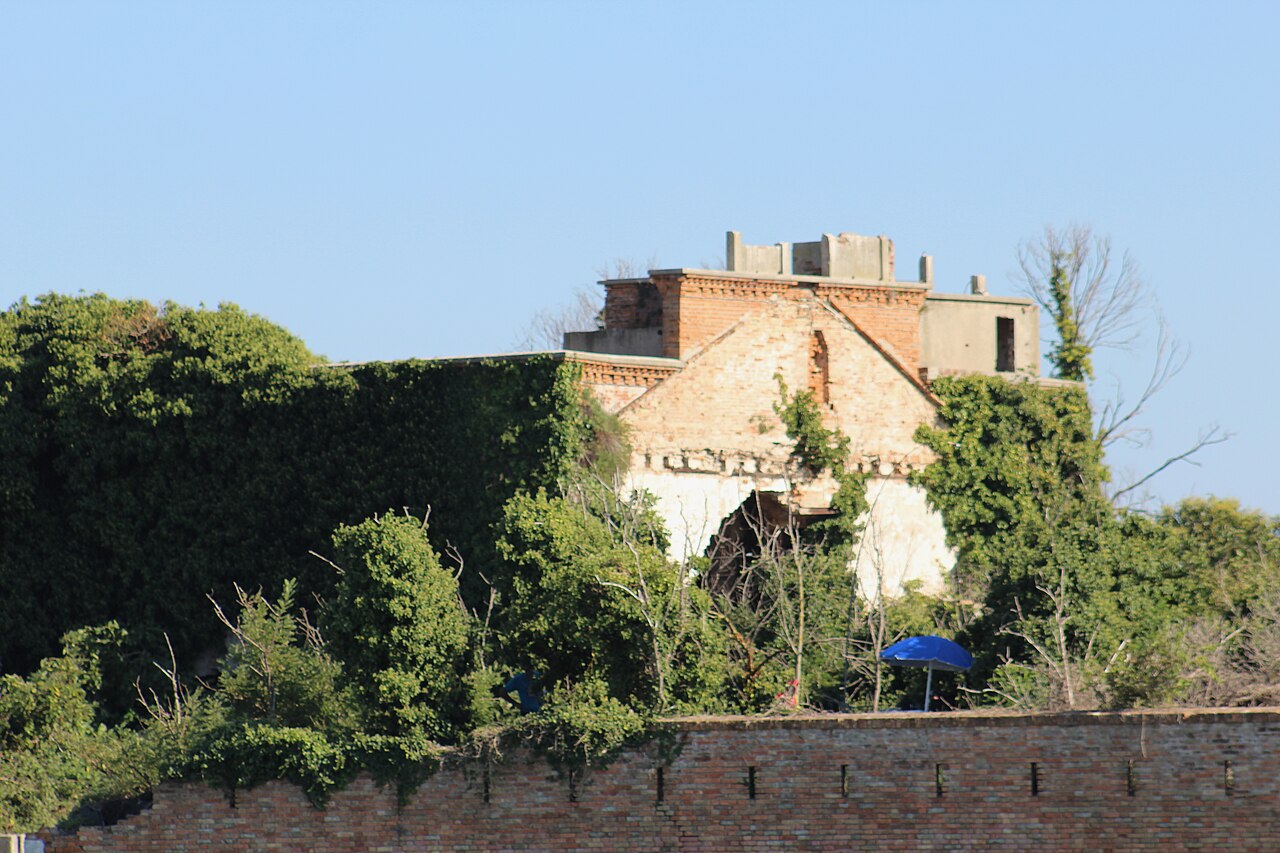
Its shoreline is defined by low masonry embankments, and the interior contains trees, thick vegetation and the remnants of former religious and military buildings. Approaching it from the water, visitors see an island that looks almost reclaimed by nature.
San Giorgio in Alga is not San Giorgio Maggiore. The latter is home to the monumental Palladian church and the Giorgio Cini Foundation. San Giorgio in Alga has a separate history, a different position in the lagoon and no organised public visitor facilities.
Why is it called San Giorgio “in Alga”?
The name combines the dedication to Saint George the Martyr with the lagoon environment. The Veneto Region’s heritage catalogue explains that the expression “in Alga” reflects the abundant seaweed historically found in the surrounding waters.
That simple name tells us something important about the island’s relationship with its landscape. Religious buildings were surrounded by shallow tidal waters, and changing water conditions have always influenced the survival of lagoon settlements.
The first monastery: Benedictines and Augustinians
Historical descriptions trace the first monastic settlement to approximately the eleventh century, associated with a Benedictine community. The church dedicated to Saint George was already known in 1144; other sources record a formal consecration in 1228. These dates refer to different types of evidence and should not be treated as contradictory foundation years.
The Veneto heritage catalogue also records an important episode in 1216, when the island reportedly received Doge Pietro Ziani, the patriarch of Aquileia and ambassadors from Padua and Treviso. Such occasions show that the small religious settlement was connected to wider Venetian political and ecclesiastical life.
During the fourteenth century, the island was associated with Augustinian religious communities. Its early history remains complex, involving different groups and periods of decline before its most influential reform began.
1397: Ludovico Barbo receives the declining monastery
By the end of the fourteenth century the monastery had few inhabitants, even though it controlled valuable resources. In 1397, Pope Boniface IX entrusted the monastery in commendam to the young Venetian patrician Ludovico Barbo.
The arrangement gave Barbo responsibility for the ecclesiastical property and its revenues. More importantly, it allowed the buildings to become a meeting place for a new generation of Venetian men interested in religious reform, communal prayer and a more demanding spiritual life.
This transition is central to understanding why San Giorgio in Alga became so influential in the early Renaissance.
1404: the religious community that changed Venice
On 30 October 1404, the reform group was formally installed at San Giorgio in Alga under a decree implemented by Angelo Barbarigo. The community became known as the Canons of San Giorgio in Alga, bringing together prayer, study and a shared way of life.
It was not simply a secluded monastery inhabited by anonymous hermits. Its members included figures from prominent Venetian families whose activities eventually shaped churches and religious institutions across northern Italy.
The Patriarchate of Venice identifies the group’s establishment in October 1404 as an important moment in the religious renewal of the city. The new community combined meditation, shared worship and the aspiration to return to the simplicity of early Christianity.
Lorenzo Giustiniani: from the island to Venice’s first patriarch
Among the most famous members was Lorenzo Giustiniani, born into a prominent Venetian family. He joined the reform movement while still young, embracing a life of prayer, service and personal austerity.
In 1433, Lorenzo became Bishop of Castello. When the Patriarchate of Venice was established in its later form in 1451, he became the city’s first patriarch. His experience at San Giorgio in Alga helped shape the spirituality and reforms for which he became known.
He died in 1456 and was later recognised as a saint. His presence connects a small abandoned island today with one of the most important figures in Venetian church history.
Gabriele Condulmer and the future Pope Eugene IV
Another member of the circle was Gabriele Condulmer, who became Pope Eugene IV in 1431. Other notable associates included Antonio Correr and Marino Querini.
It is remarkable that a community founded on a small lagoon island became associated with future leaders of the Catholic Church. The group’s ideals, activities and networks were part of a larger movement that sought to improve religious discipline and education before the Reformation.
The island thus played a role far beyond its physical size: it was an intellectual and spiritual centre as well as a place of prayer.
The rebuilding of the church, monastery and bell tower
The success of the community was followed by substantial building work. The FAI – Fondo per l’Ambiente Italiano records that the monastery was completed in 1443, the bell tower in 1454 and the church in 1458.
These dates reveal how the medieval structures developed into a larger architectural complex. Church, cloisters, communal rooms and the bell tower would have given San Giorgio in Alga a very different skyline from the ruined vegetation-covered island visible today.
Historical drawings and views preserve elements of these lost buildings, offering a glimpse of how prominent the island once appeared on the lagoon’s waterways.
1668: the congregation is suppressed
In 1668, Pope Clement IX suppressed the congregation. Older accounts sometimes attribute the decision primarily to declining religious discipline, but modern research also emphasises its political and financial context.
The Venetian Republic was heavily involved in the War of Candia (Crete), and the redistribution of church property could help finance the conflict. Research by historian Giulia Zanon, published in 2023 and 2024, examines these financial and institutional pressures.
The end of the congregation was therefore not simply the story of a monastery becoming less devout: it was linked to the broader concerns of the Venetian Republic and the Catholic Church during a long Mediterranean war.
The Minims and the Discalced Carmelites
Following the suppression, the island passed to the Minims of Saint Francis of Paola in the period 1669–1699. These religious men, sometimes called Paolotti in Venetian sources, faced difficulties maintaining the property and eventually left.
The Discalced Carmelites subsequently occupied the monastery, undertaking major renovation projects between approximately 1690 and 1716, according to the FAI’s chronology. The changeover and rebuilding are described differently in some historical sources, but both orders formed part of the island’s later religious history.
The monastery’s functions evolved with its successive communities, even as the island remained a place of prayer, work and regular boat connections with Venice.
1717: a fire destroys the religious complex
A serious fire in 1717 damaged or destroyed much of the rebuilt religious complex. New construction followed, and the design of a later church has been attributed to the Venetian architect Andrea Tirali.
The repeated cycle of building, fire and rebuilding explains why ruins from different periods eventually stood together on the island. San Giorgio in Alga was never an unchanged medieval monument; it constantly adapted to new religious communities and new circumstances.
1806: the monastery becomes a military site
Following the fall of the Venetian Republic and the Napoleonic changes to religious institutions, monastic life ended in 1806. The friars were transferred away, the church was eventually dismantled and surviving structures were converted for military use.
Earlier Austrian administrations had also used parts of the complex as a political prison and begun military adaptations. The island later served as a gunpowder magazine, taking advantage of its separation from the densely inhabited city.
This was a dramatic change in function: rooms once intended for worship or communal living became places for storing military material.
San Giorgio in Alga during the Second World War
The island retained a military purpose under successive administrations. During the Second World War, it housed a munitions depot and an anti-aircraft battery associated with the defence of the Porto Marghera area.
The FAI records that the island was bombed in 1945, adding to the destruction of already altered buildings. Modern photographs show remains of brickwork and military constructions partly enveloped by vegetation.
It is important to distinguish historical records from stories about secret tunnels or hidden treasure. Such legends sometimes accompany abandoned islands, but they do not establish the presence of undiscovered treasures.
From the Patriarchate to the City of Venice
After the war, San Giorgio in Alga had no lasting new institutional purpose. Local recollections describe brief periods when families cared for some spaces or cultivated land, but these did not reverse the gradual deterioration.
In 1961, the Patriarchate of Venice acquired the island. In 1973, it transferred the property to the City of Venice, according to the FAI’s historical summary.
Although its religious and military significance is well documented, the island has not experienced the comprehensive recovery seen on some other lagoon islands. Conservation concerns, damaged structures and questions about future use remain.
What remains of San Giorgio in Alga today?
Modern photographs show fragments of brick walls, arches, waterfront buildings and military remains among thick vegetation. Many of the structures are visibly damaged, with missing roofs and deteriorated masonry.
Even small fragments reveal the multiple uses of the island: the different construction phases reflect monastic building, later renovation and military adaptation. The ruins are a reminder of how heritage can disappear when an island loses its resident community and regular maintenance.
The FAI has included San Giorgio in Alga among the places recognised through its “I Luoghi del Cuore” campaigns, reflecting public interest in preserving its history and protecting what survives.
Can you visit San Giorgio in Alga?
San Giorgio in Alga is not an ordinary visitor attraction. There is no regular public waterbus service to the island, no published programme of guided visits and no maintained public route through the ruins.
Because the buildings are in a state of deterioration, entering without official permission may be both unsafe and unauthorised. The absence of a ticket office or fence should not be interpreted as permission to land or explore unstable buildings.
The island’s outline can be seen from surrounding navigable lagoon waters, respecting navigation regulations and the restrictions that apply to nearby industrial and shipping routes. Any actual landing would require confirmation from the responsible authorities.
Discover the forgotten islands of Venice by private boat
From the water, San Giorgio in Alga is a powerful example of Venice’s lesser-known history: a tiny religious centre that influenced the church, then served as a military outpost before falling into disuse.
Its story can be compared with that of La Certosa, which developed from monastery to military site and later marina, or San Giacomo in Paludo, another small island shaped by centuries of changing use.
For a customised introduction to the lagoon from the water, explore our private Venice island boat experiences or contact us. Any possible route near San Giorgio in Alga depends on navigation conditions; a private boat experience does not include landing on or entering its ruins.
Explore more stories in History of the Venetian Lagoon Islands.
Frequently asked questions
Why is the island called San Giorgio in Alga?
It combines the dedication to Saint George with the abundant seaweed that historically grew in the surrounding lagoon waters.
What happened at San Giorgio in Alga in 1404?
A reformed religious congregation was established there, associated with Lorenzo Giustiniani and Gabriele Condulmer, the future Pope Eugene IV.
Why was the monastery abandoned?
Monastic life ended during the Napoleonic suppressions in 1806. Buildings were adapted to military uses, damaged during the Second World War and later left without a lasting purpose.
Can visitors land on San Giorgio in Alga?
No regular tourist landing or public visit programme is available. The ruins are unsafe and access requires permission from the relevant authorities.
Historical sources and photo credits
Sources: FAI – San Giorgio in Alga; Veneto Region – architectural heritage catalogue; Patriarchate of Venice – religious reform and Lorenzo Giustiniani; Treccani – Angelo Barbarigo and the 1404 foundation; Giulia Zanon (2023), research on the Minims and the island. Featured photograph: Oursana / Wikimedia Commons, CC0 1.0, photographed in 2023 and resized to 1280 px. Other images are credited in their captions.