Between Burano and Sant’Erasmo lies a small green island where silence, prayer and the history of Venice have been intertwined for almost eight centuries. San Francesco del Deserto is home to a Franciscan monastery still inhabited by friars, surrounded by cypress trees, gardens and the waters of the northern Venetian Lagoon.
Its story begins long before the monastery was built. Archaeological traces reveal an earlier settlement, while Franciscan tradition recalls the arrival of Saint Francis of Assisi around 1220. The island’s name, its medieval church and its surviving cloisters tell a remarkable story of devotion, abandonment, military occupation and renewal.
Where is San Francesco del Deserto in Venice?
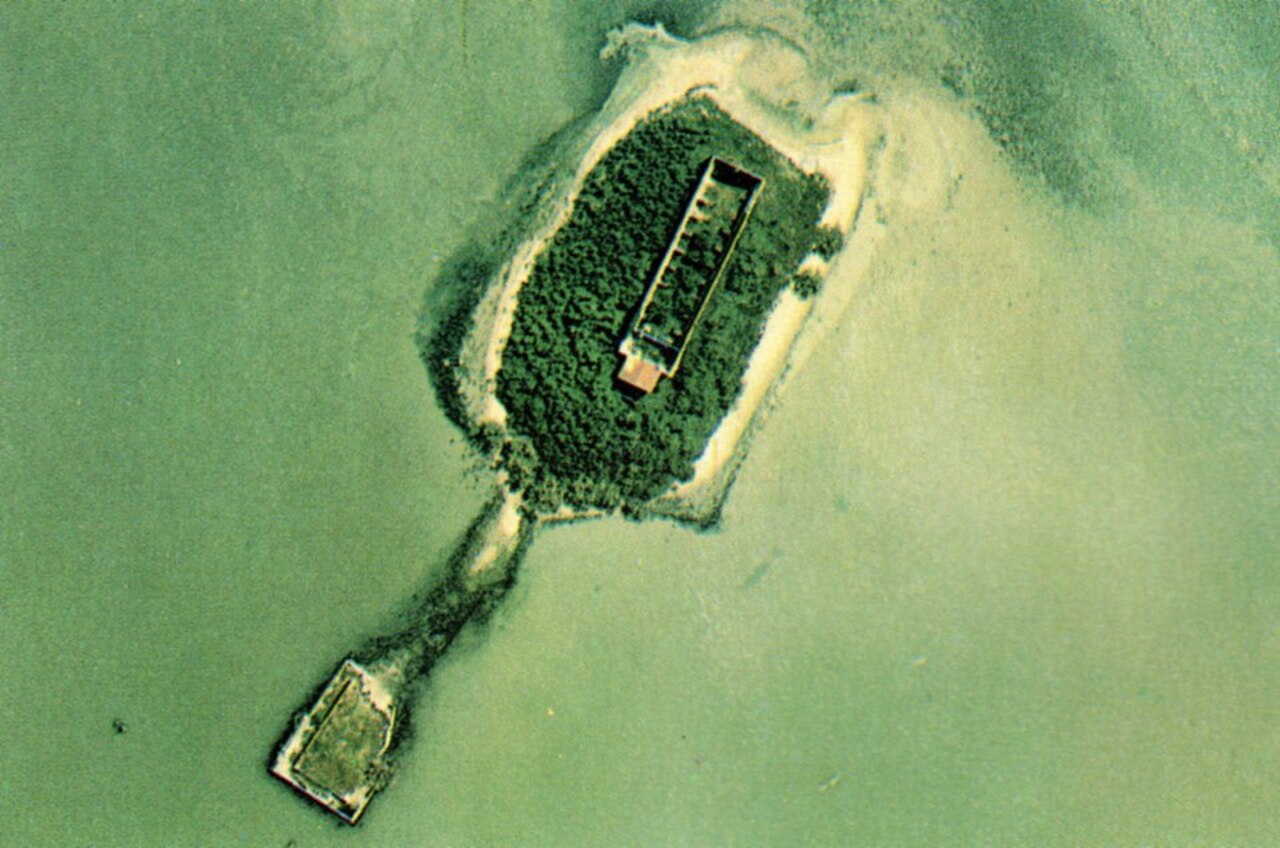
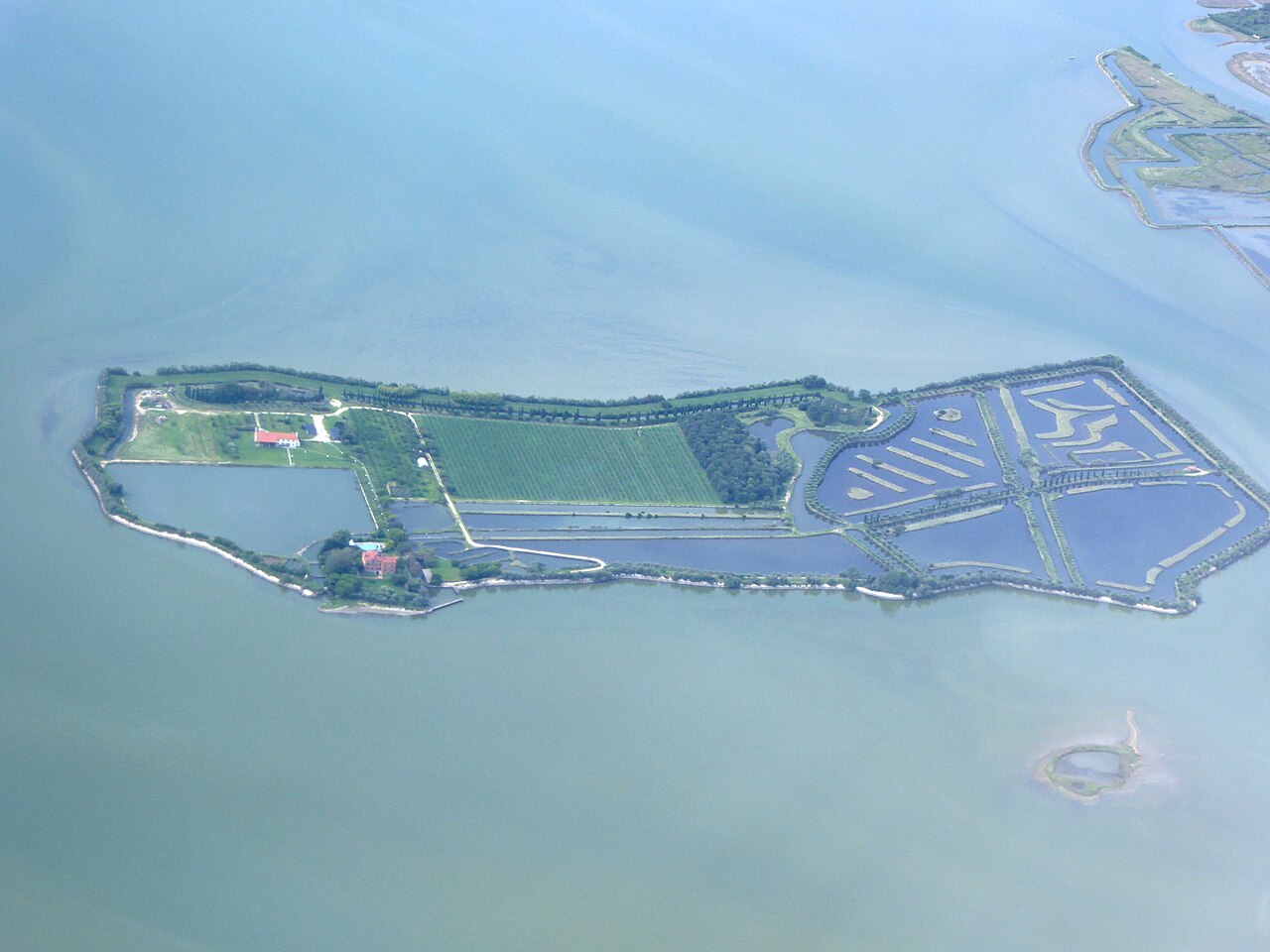
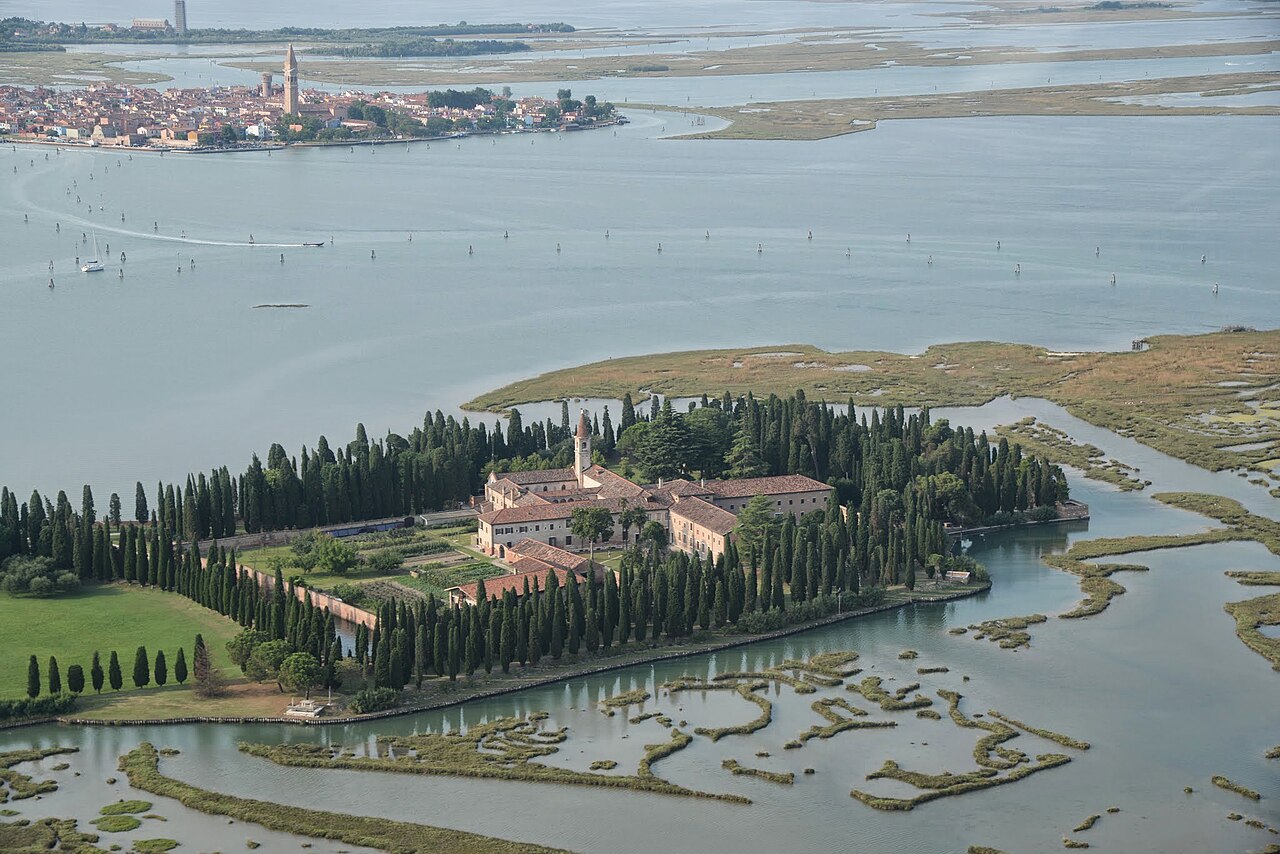
San Francesco del Deserto is a small island of approximately four hectares in the northern Venetian Lagoon, between Burano and Sant’Erasmo, near Torcello. From the water, a cluster of terracotta roofs and a bell tower rises above rows of cypress trees, enclosing the quiet Franciscan complex.
Unlike the busy streets of Venice, it has no tourist shopping district or public waterbus landing. It remains a place of religious life. Its historical and spiritual character is precisely why visits follow the friars’ rules rather than the schedule of an ordinary public attraction.
Before Saint Francis: the Island of the Two Vineyards
San Francesco del Deserto was formerly called Isola delle Due Vigne, or “Island of the Two Vineyards”. The name recalls cultivated land in a part of the lagoon historically connected with rural settlements, fishing, travel by boat and the nearby religious centre of Torcello.
Archaeological investigations, particularly those conducted between 1961 and 1965, uncovered material indicating human activity in the Roman period, with remains associated with the first, fourth and fifth centuries AD.
This evidence shows the site was used long before the arrival of the Franciscans. However, the Roman finds do not prove that the present monastery or the story of Saint Francis can be dated to antiquity; they belong to different chapters in the island’s history.
Did Saint Francis of Assisi really visit in 1220?
According to Franciscan tradition, Saint Francis stopped on the island in the spring of 1220, while returning from the eastern Mediterranean. He had travelled to Egypt and met Sultan al-Malik al-Kamil during the Fifth Crusade, choosing dialogue rather than armed confrontation.
The friars’ own history suggests that Francis may have arrived in the Torcello area before withdrawing to the small island to pray. The exact identification of the island and the details of the visit belong to religious tradition rather than independently conclusive documentary proof. Historical writers do not all consider the account equally certain.
Whether encountered as history or tradition, it explains why San Francesco del Deserto became a place associated with Franciscan simplicity, contemplation and peace.
The birds of San Francesco del Deserto: an important Franciscan story
One of the best-known stories is associated with Saint Bonaventure’s biography of Saint Francis. According to the account, Francis and his companion tried to pray, but a multitude of birds sang so loudly that they could not recite their prayers. Francis addressed the birds, which fell silent until the prayer had ended.
The episode is a religious and literary tradition, not an event that can be verified through archaeology. It nevertheless expresses a central theme of Franciscan spirituality: the relationship between human beings, nature and the praise of creation.
That message is still visible in the island’s trees, quiet gardens and outdoor artworks inspired by the Canticle of the Creatures.
1228–1233: Jacopo Michiel and the foundation of the monastery
The documented medieval history of the island is clearer. The Venetian patrician Jacopo Michiel, its owner, was associated with the construction of an early church dedicated to Saint Francis around 1228, the year Francis was canonised.
In March 1233, Michiel donated the island to the Friars Minor, connected with the Franciscan community at the Frari in Venice. The gift allowed the development of a permanent monastery, transforming the older “Island of the Two Vineyards” into a centre of religious life.
The date is especially meaningful: only a few years after Francis’s death in 1226, his followers already had a place in the Venetian Lagoon dedicated to his memory.
The church of San Francesco: medieval layers beneath the building
The church visible today contains traces of several phases. According to the monastery’s architectural guide, an early thirteenth-century church occupied part of the area of the present sanctuary. A later single-nave church, with an exposed timber roof, was built in 1401 thanks to the patronage of Frangola Giustinian.
Excavations revealed walls, foundations and architectural details beneath later floors and extensions. The result is a building that cannot be understood as the unchanged work of one century: its structure reflects successive communities and reconstructions.
The national heritage catalogue lists the church and convent as protected historic buildings, making this small island part of Venice’s wider architectural heritage.
Why is it called “del Deserto”?
The word “Deserto” does not mean that the island was a sandy desert. It refers to a period when the monastery became deserted or abandoned.
During the early fifteenth century, unhealthy environmental conditions and the decline of the monastic community led the friars to leave. Some historical accounts place the abandonment around 1420 and the resumption of religious life in 1453.
The name preserves that chapter of isolation. It is also a reminder that living on a small lagoon island was not always idyllic: changing water conditions, disease and difficult transport could make permanent settlement challenging.
1453: the Franciscan Observants and the renewal of the cloisters
In 1453, the Franciscan Observants returned to restore the church and monastery. They built or renewed spaces suited to communal prayer and residence, including the elegant cloister that visitors associate with the island today.
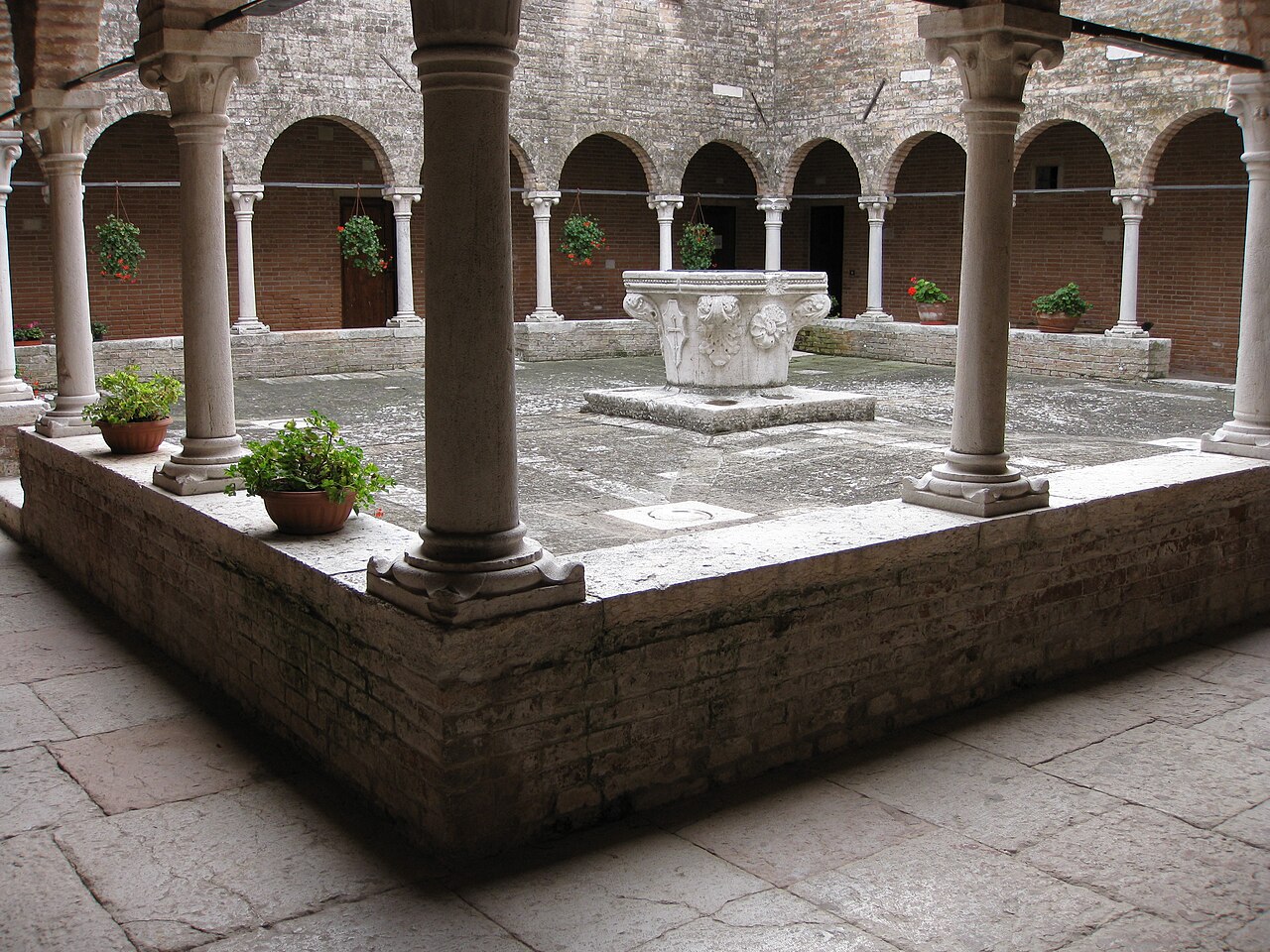
The complex includes two cloisters reflecting different periods. The monastery identifies the second as a late-fifteenth-century work associated with Friar Nicolò Erizzo, active as guardian between 1452 and 1460. Its arches, well and enclosed courtyard reveal the characteristic intimacy of Franciscan architecture.
Over the following centuries the buildings were adapted as the needs of the community changed. One cloister was later reconstructed after the nineteenth-century return of the friars.
1806: Napoleon and the transformation into a military island
The monastery faced another interruption during the Napoleonic occupation. In 1806, the suppression of religious institutions forced the friars to leave San Francesco del Deserto.
The buildings were repurposed for military use. Former cells and communal areas became a barracks and storage space for explosives; the island later served Austrian military needs as well. The religious character of the place was temporarily replaced by the practical demands of defending Venice.
This phase brought damage and alterations. The monastery visitors see today survived not because it was untouched, but because it was restored after the military period ended.
1858: the friars return to San Francesco del Deserto
During the 1850s, the island was returned to the religious authorities and the Franciscan community was able to re-establish itself. The friars returned in 1858, beginning a further period of repair and reconstruction.
Restoration brought renewed attention to the church, cloisters, walls and grounds. Later investigations in the twentieth century helped reveal the oldest foundations and the archaeological history of the island.
Today San Francesco del Deserto is not an abandoned monument. It remains an inhabited Franciscan monastery, a distinction that shapes both its atmosphere and the rules for visitors.
The monastery today: two cloisters, a church and quiet gardens
A typical visit introduces the historic church, the cloisters and part of the garden. Rows of tall cypress trees and green paths surround the buildings, creating a contrast with the bustle of Burano and Venice.
The monastery’s guide also describes traces of the earliest chapel, historic wells, a newer choir for the friars’ prayer and outdoor artworks recalling the Canticle of the Creatures.
Not every room or garden path is open to the public. Some areas are reserved for the friars’ private life and religious activities. Visitors are invited to respect silence, punctuality and the devotional character of the complex.
How to visit San Francesco del Deserto: official opening hours
According to the Franciscan monastery’s official website, visits are possible Tuesday to Sunday, excluding Mondays and any exceptional closure days decided by the community. Visits are guided by a friar and take approximately 40 minutes.
The published tour start times are 09:00, 09:45, 10:30, 15:00, 15:45 and 16:30. There is no fixed admission ticket; visitors are invited to make a voluntary donation to support the maintenance of the island.
Groups must arrange their visit in advance; the monastery states that it does not accept group bookings more than two months before the chosen date. Hours can change for religious celebrations and the needs of the community, so always consult the official guided-visit information before travelling.
Getting there from Venice or Burano: why a separate boat is needed
There is no direct ACTV public waterbus service stopping at San Francesco del Deserto. From Venice, visitors generally reach Burano by the public waterbus network, then arrange a separate private boat or local shuttle for the final crossing.
The friars also publish contact details for a Burano shuttle operator and explain that private boats and water taxis may reach the island. Transport should be organised before arrival, bearing in mind the guided-tour schedule and any group-booking requirements.
The official monastery contact page gives up-to-date contact details. Reaching an island by private boat does not automatically confer the right to enter the convent outside its visiting arrangements.
Explore the northern lagoon by private boat
The waters between Burano, Torcello and Sant’Erasmo bring together some of the lagoon’s earliest settlements, working agricultural islands and quiet religious retreats.
To discover this landscape from the water, explore our private boat experiences in Venice’s lagoon or contact us to discuss a customised itinerary. Stops and entry at San Francesco del Deserto must be agreed in accordance with the monastery’s published rules; a visit cannot be guaranteed simply by booking a boat.
For more ideas, read our guide to visiting San Francesco del Deserto by boat and the collection History of the Venetian Lagoon Islands.
Frequently asked questions
Did Saint Francis visit San Francesco del Deserto?
Franciscan tradition places a visit by Saint Francis of Assisi here around 1220, after his journey to Egypt. The visit is a longstanding devotional account; the documented donation to the Friars Minor dates to 1233.
Why does the island have “Deserto” in its name?
The name recalls a period of abandonment in the early fifteenth century, when unhealthy conditions and a declining community caused the monks to leave. It does not describe a sandy desert.
Can you visit the Franciscan monastery?
Yes, normally Tuesday to Sunday on guided visits led by a friar. The monastery publishes six tour start times and asks groups to book ahead; details can change.
Is there a public vaporetto to San Francesco del Deserto?
No. Visitors generally travel to Burano by ACTV and arrange a separate local shuttle, private boat or water taxi for the final crossing.
Historical sources and photo credits
Sources: Franciscan monastery – History; Franciscan monastery – Architectural visit; Official visiting hours and guided tours; City of Venice – History of the convent; Meeting Venice – Historical context. Featured photograph: Anton Nosik / Wikimedia Commons, CC BY 3.0; resized to 1280 px. Other photographs credited in captions.