Beside the bridge that brings travellers into Venice lies the almost forgotten island of San Secondo. Once a Benedictine convent and later a Dominican monastery, it became a quarantine site, a military installation and eventually an abandoned island.
San Secondo near Venice’s mainland causeway
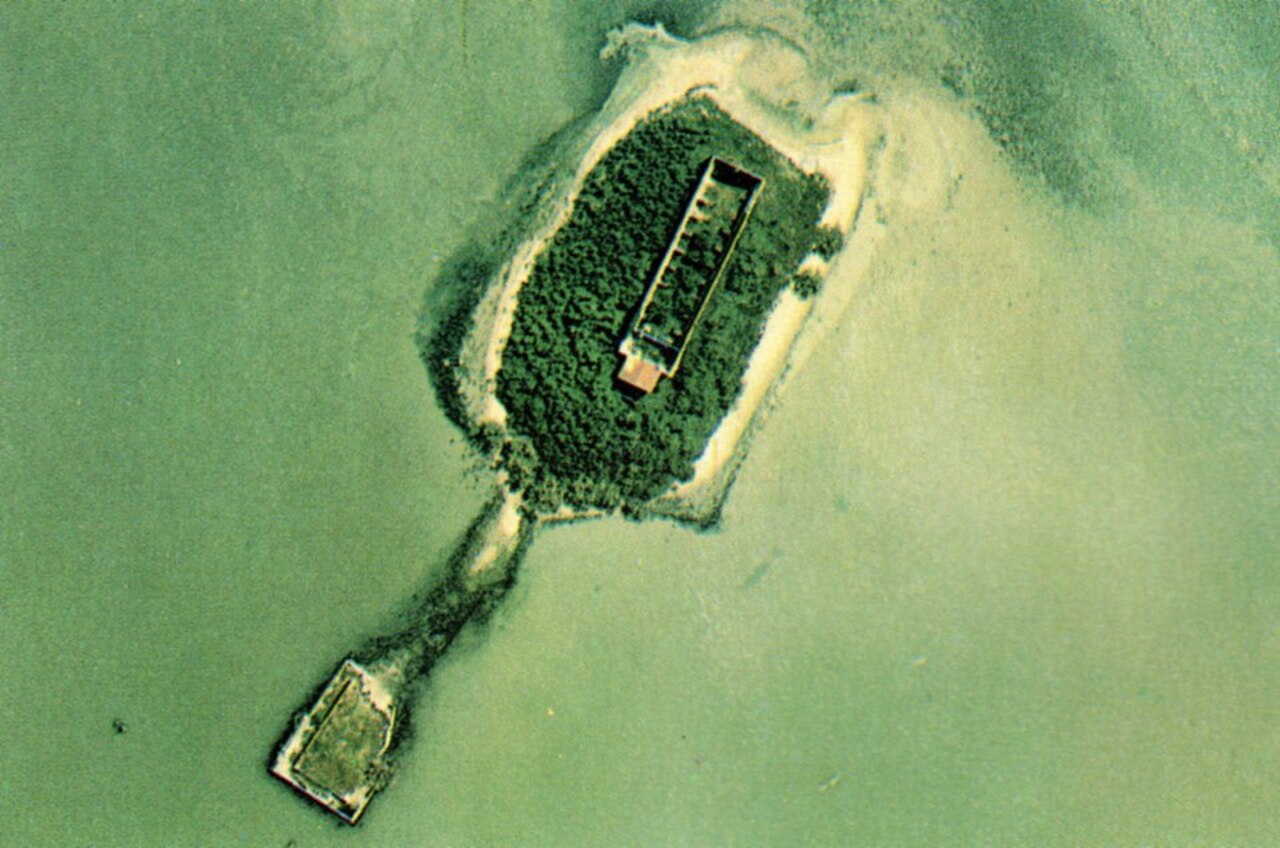
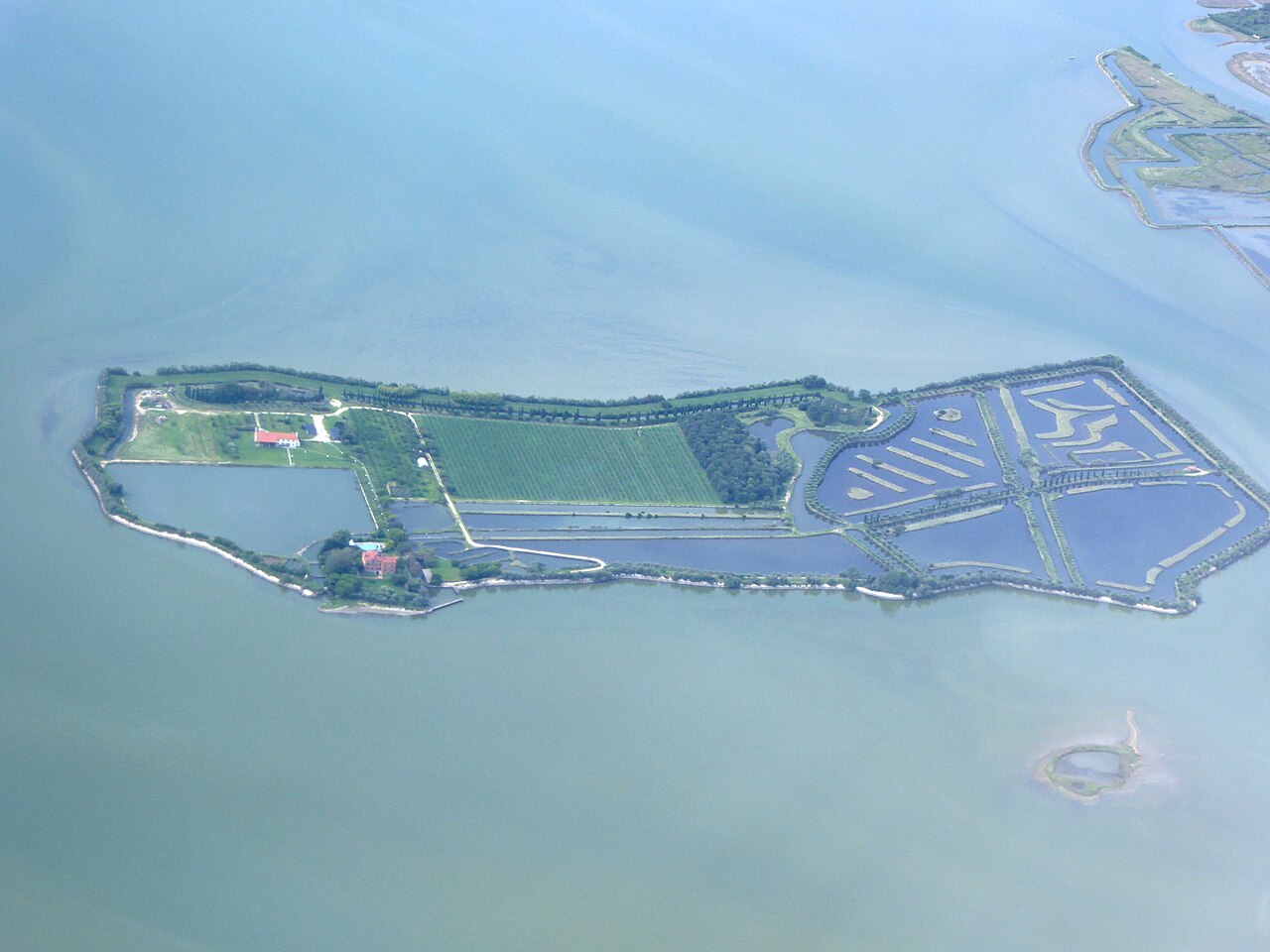
San Secondo is a small island in the western Venetian Lagoon, close to the Ponte della Libertà linking Venice to the mainland. Thousands of travellers pass nearby by road and rail without noticing that the overgrown land once held a substantial monastery. Its history includes a medieval devotion to Saint Erasmus, the arrival of relics from Asti, Benedictine and Dominican communities, plague quarantine and military facilities. It is not a regular public attraction.
1034: a church for Saint Erasmus
An important historical tradition dates the foundation of a church and Benedictine convent to 1034. It associates the initiative with the Venetian Basso or Baffo family, whose surname appears differently in sources. The first dedication was to Saint Erasmus, traditionally invoked by sailors seeking protection during storms. The island lay near busy waterways linking Venice and the mainland, giving its religious site a prominent position in lagoon life.
Benedictine nuns and Venetian patronage
The early community consisted of Benedictine nuns, including women connected with Venetian noble families. Donations and property income supported religious life, but historical accounts also recall periods of poverty. A ducal grant associated with Vitale Falier in 1089 illustrates the relationship between the convent and the state. Monasteries on islands needed boats for communication, supplies, construction and participation in the wider life of the Republic.
1237: the relics of Saint Secondo from Asti
The island received a new religious identity when the relics of Saint Secondo were brought from Asti, traditionally dated to 1237. The church came to be known by the joint dedication to Saints Erasmus and Secondo, and the island gradually adopted its present name. Such relic transfers could attract devotion, donations and prestige. Today the saint’s remains are no longer kept on the abandoned island; later transfers followed the suppression of its religious institutions.
The sixteenth-century crisis and arrival of Dominicans
During the first decades of the sixteenth century the Benedictine community declined. The papal authorities suppressed its independent existence around 1531 and the nuns moved to another Venetian institution. The site subsequently passed to Dominican friars; academic research identifies their establishment from around 1540. They rebuilt and reorganised the complex, including major works associated in 1563 with the architect Giovanni da Zon. These changes show how the same island could support very different communities over time.
1570: gunpowder storage and the mainland customs route
San Secondo had a strategic location near the routes from Mestre and Marghera. After a serious fire at the Venetian Arsenal, the Senate ordered a separate gunpowder tower in 1570 to reduce the danger of storing explosive material in crowded parts of Venice. The island also had a customs collection point for goods arriving from the mainland. Religious and state activities therefore existed in close proximity, not always without conflict.
1575–1577: San Secondo as a quarantine site
During the severe plague epidemic of 1575–1577, the island was temporarily used for public-health activities. Initially part of the grounds was required for the treatment and disinfection of goods; later the friars had to leave while the complex functioned as an outstation of the Lazzaretto Nuovo. When conditions improved, the religious community returned and repaired the damaged buildings. This was a temporary adaptation, not proof that San Secondo had been founded as a plague hospital.
A rebuilt church in 1608
The seventeenth century saw further rebuilding, and the church was consecrated in 1608 according to historical accounts. The Dominican community continued to manage the monastery for nearly two more centuries. The island’s presence in old maps and paintings is a reminder that its present condition as an overgrown ruin is historically recent. The church and its religious furnishings were once visible to boat traffic approaching Venice.
1806: the end of monastic life
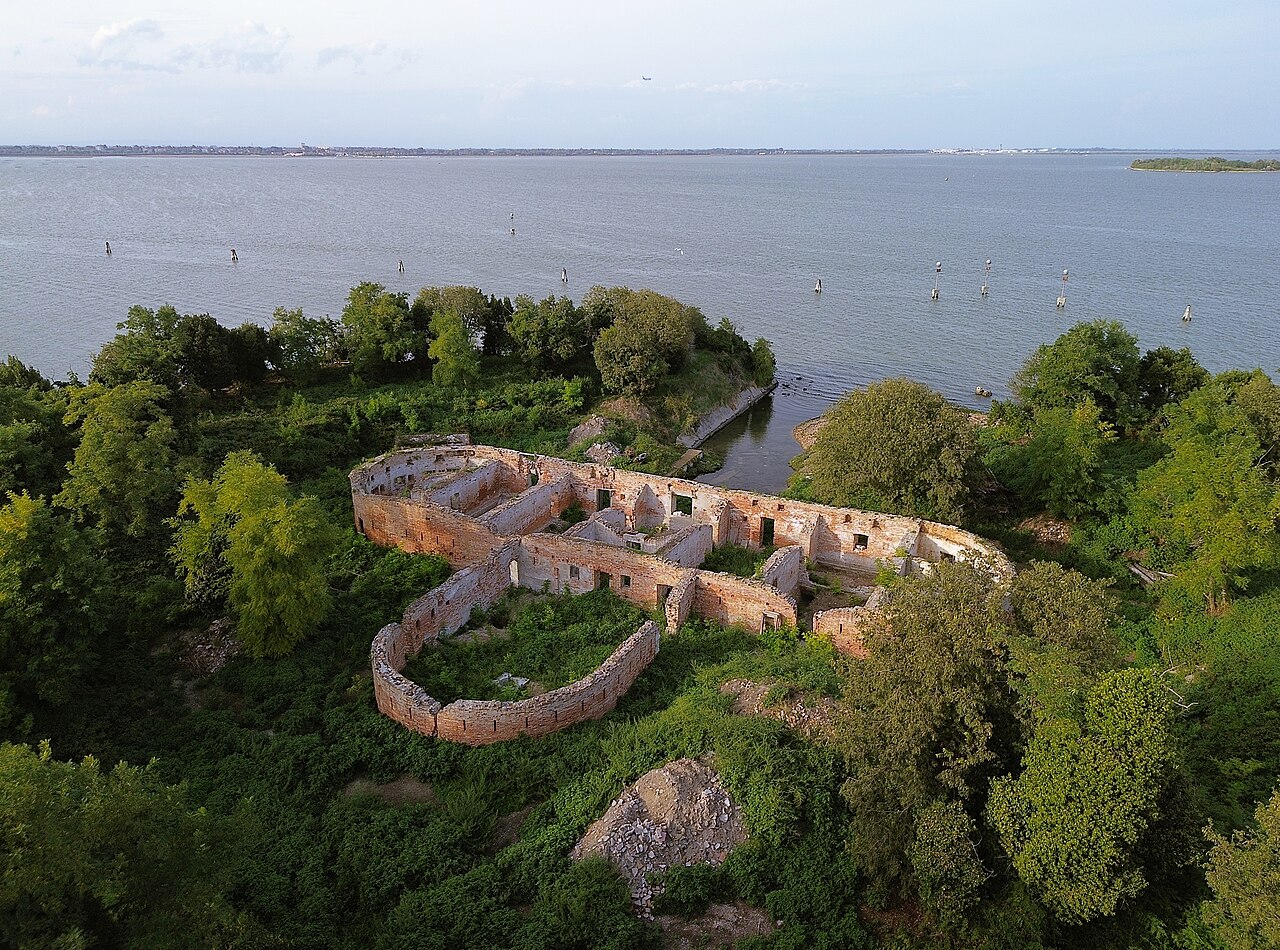
Following the fall of the Venetian Republic in 1797, Napoleonic policies resulted in the suppression of the monastery in 1806. The Dominican community was transferred to other premises in Venice, and the relics of Saint Secondo were moved. Military authorities later took over the island. The church was demolished by the nineteenth century, with sources referring to 1824, and the former religious buildings were replaced or transformed for military purposes.
Military island, abandonment and the modern causeway
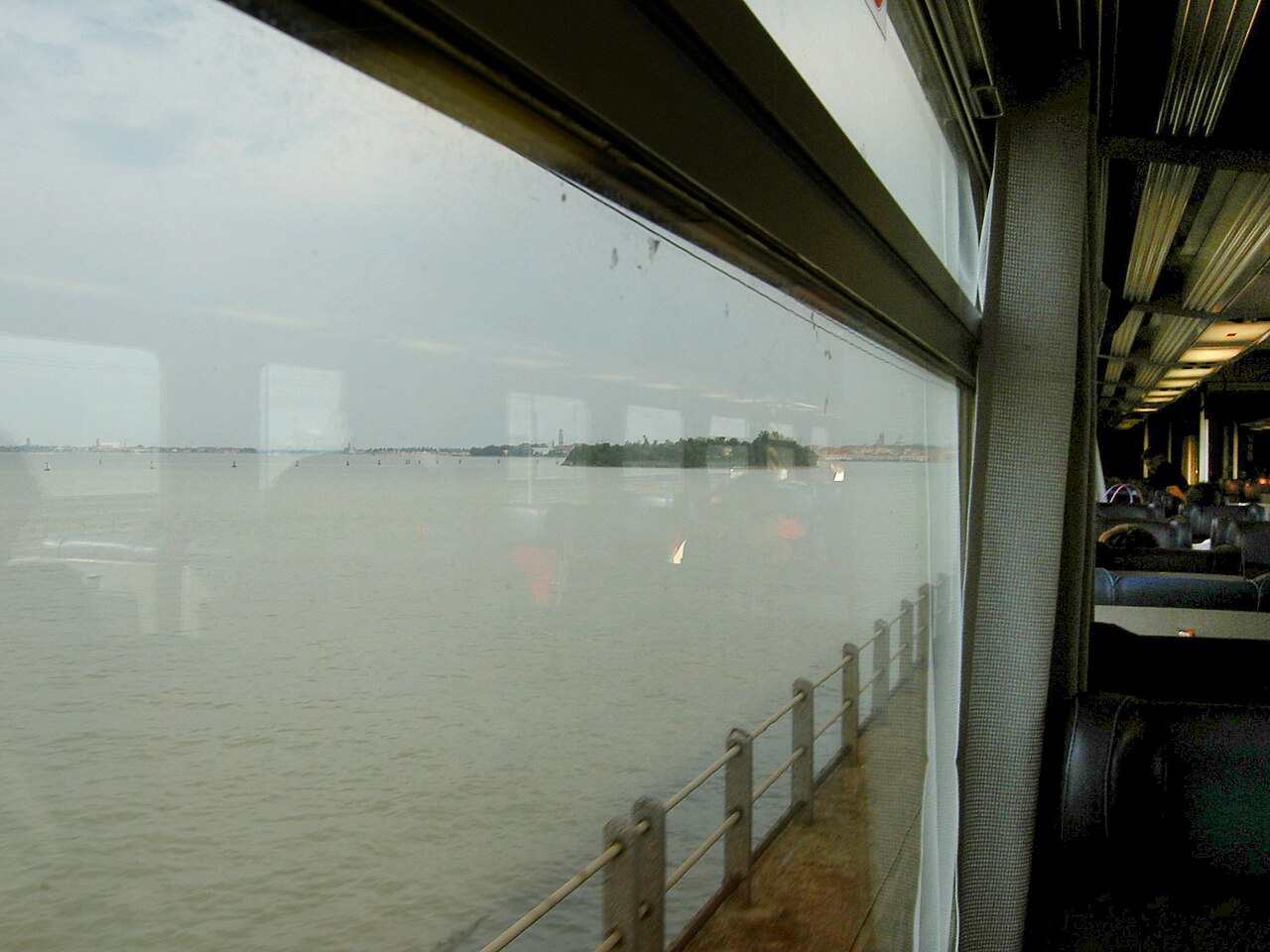
San Secondo remained tied to military functions long after the convent disappeared. The nearby mainland connection eventually changed the surrounding landscape: the modern Ponte della Libertà makes the island visible to travellers but does not provide a public walking entrance. The buildings have deteriorated and vegetation covers much of the site. The distinction between visibility from a train and safe access to an abandoned island must be clear.
Can San Secondo be visited today?
San Secondo is not an ordinary public visit site. Its position near the causeway may make it seem accessible, but there is no normal pedestrian route or public landing for sightseeing. The former military infrastructure and deteriorated buildings may be dangerous. Viewing the island from public transport or navigable waters is different from permission to go ashore, and access should only take place with authorisation.
Discover its history alongside other lagoon islands
San Secondo illustrates how Venice reused monasteries when public-health emergencies, state needs or military requirements changed. Compare the island with the Lazzaretto Nuovo and La Certosa. To discuss a private itinerary that explores Venice’s changing island landscape from the water, contact us. An approach or landing is never promised without verified navigation and access conditions.
Why the island was suitable for quarantine
San Secondo’s position between Venice and the mainland made it useful both for trade and for isolating potentially dangerous goods. During the plague of 1575–1577 the authorities could separate people and materials from the crowded city while using boats to supply the site. The Dominican friars initially shared the island with emergency activities before being forced to leave temporarily. This shows how public-health measures could override the ordinary religious functions of even a long-established monastery. The work was tied to the wider quarantine network centred on Lazzaretto Vecchio and Lazzaretto Nuovo, but San Secondo was never identical to either of those specialised islands.
The disappearing religious buildings
Historic images of San Secondo show the presence of church and monastic buildings that have not survived. The Giacomo Guardi view and older records help reconstruct a shoreline once dominated by a recognisable religious complex. The later military occupation replaced much of that environment. For modern visitors, distinguishing buildings that appear in historic paintings from those surviving in aerial photographs is essential: the ruins cannot be confidently read as parts of the 1034 foundation or the seventeenth-century church without archaeological evidence.
San Secondo and Venice’s changing western entrance
The island stood on routes used to reach Venice from the mainland well before modern bridges existed. Boats carried goods, passengers and supplies across the lagoon. Later railway and road infrastructure dramatically changed the landscape without making San Secondo an accessible part of the city. Today its visibility from the Ponte della Libertà makes it easy to recognise, yet its history remains largely hidden. It is a reminder that the city’s familiar gateway occupies a much older system of maritime connections.
Frequently asked questions
Where is San Secondo?
It lies beside the mainland approach to Venice, near Ponte della Libertà.
Why was the island named San Secondo?
The name follows the arrival of the saint’s relics from Asti, traditionally dated to 1237.
Was San Secondo used during a plague?
Yes. During 1575–1577 it temporarily supported public-health measures connected to quarantine.
Can you visit the island?
No regular public access is established. Proximity to a bridge does not authorise entry.
Explore more: discover the history of the other Venetian Lagoon islands.
Explore the lagoon by boat: discover our private boat tour in the Venetian Lagoon. Routes are customisable; stops and island access depend on permissions and navigation conditions.
Historical sources and image credits
University of Padua: historic Venetian island cloisters; San Secondo historical records; Treccani – lagoon islands. Featured photo: Liviux / Wikimedia Commons, CC BY-SA 4.0; internal photo: Eweht / Wikimedia Commons, CC BY-SA 4.0.