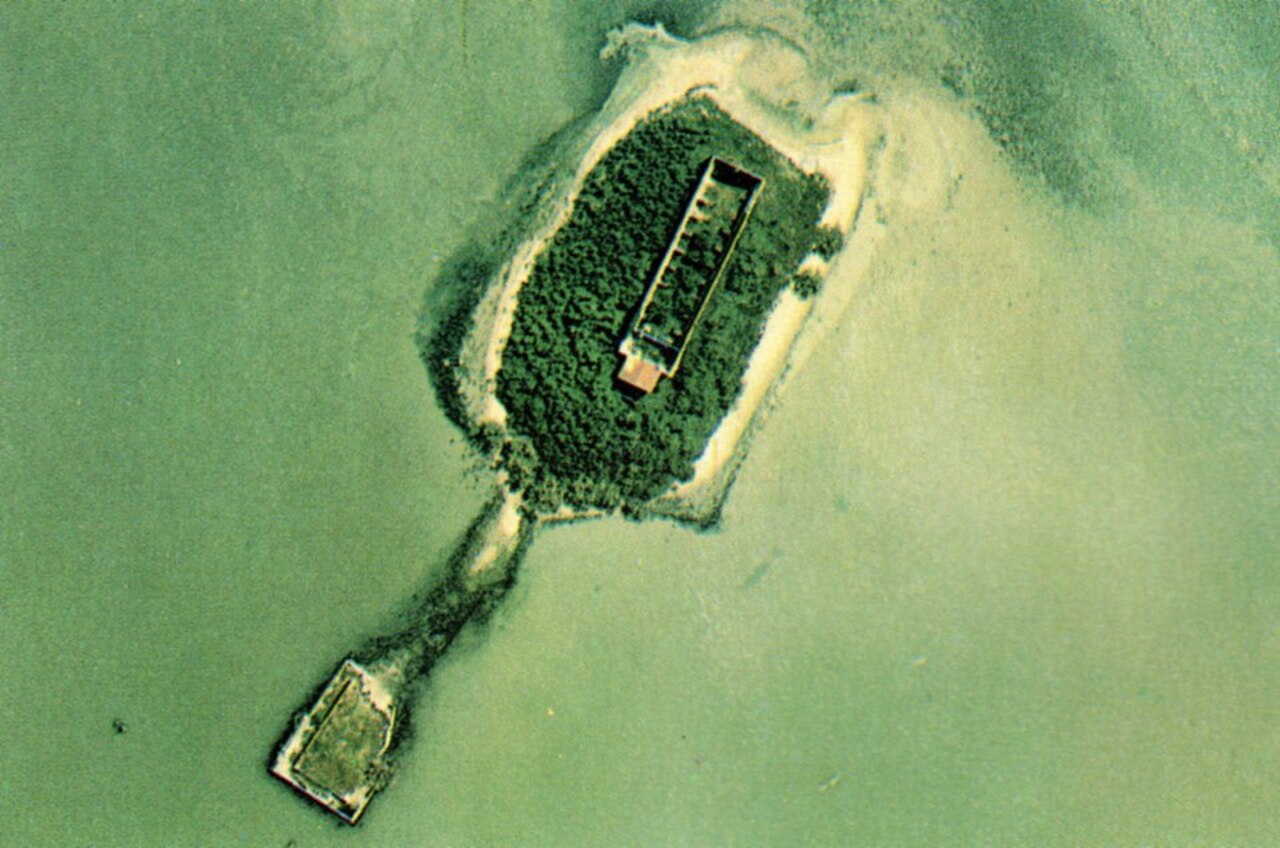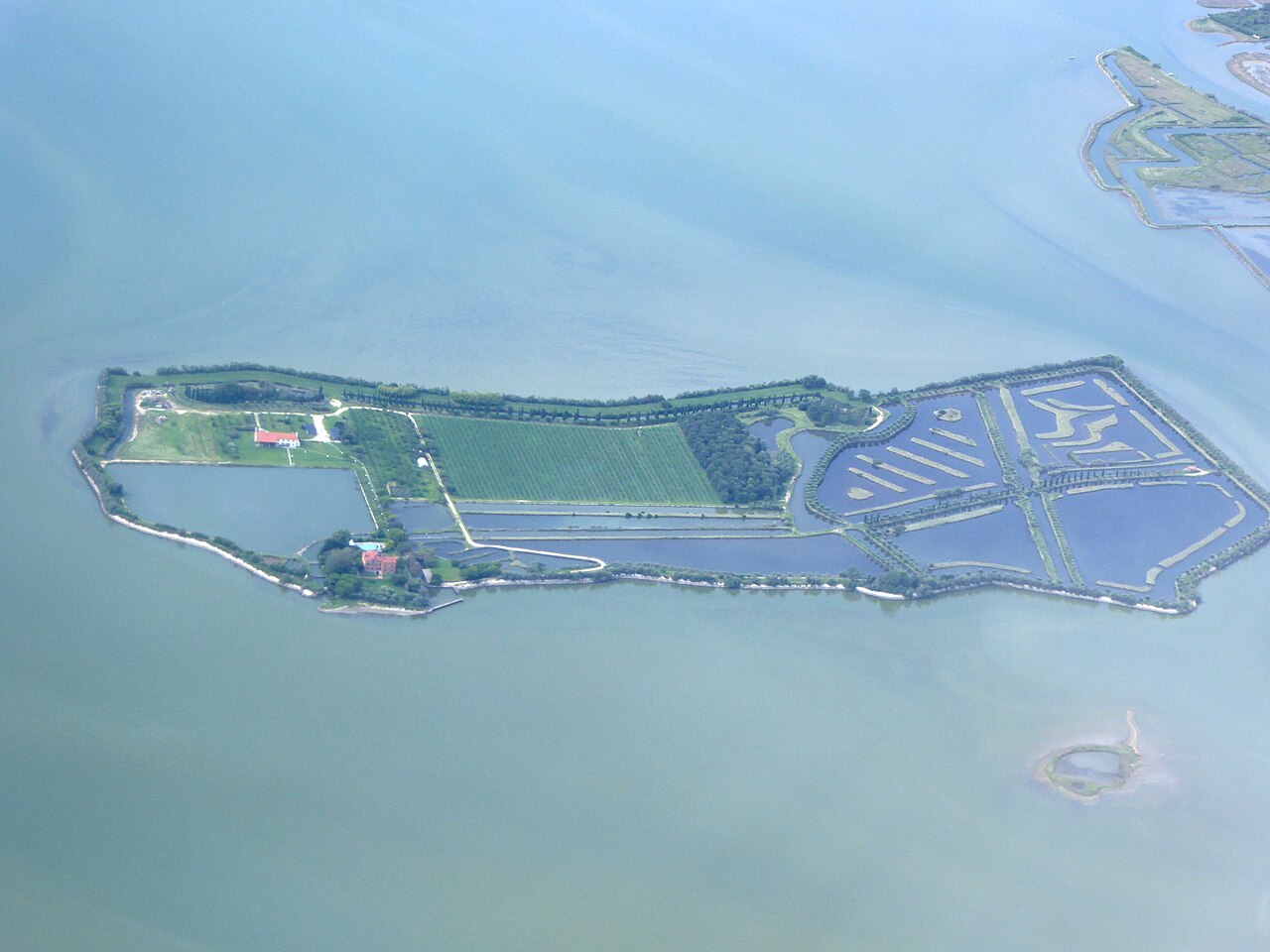
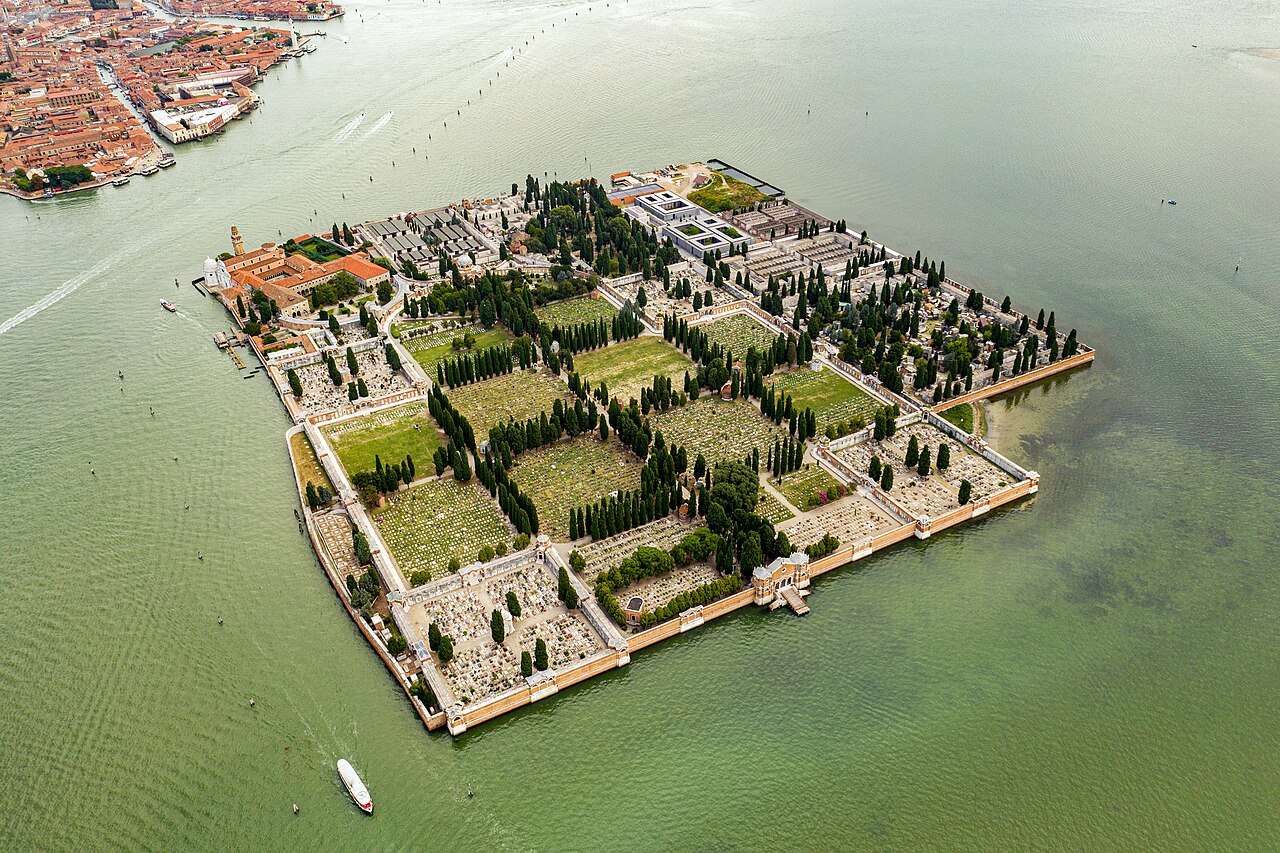
Between Venice and Murano, an island enclosed by brick walls and tall cypress trees holds a special place in the life of the city. San Michele is Venice’s main cemetery, but it was not always dedicated to burials. For centuries it was home to Camaldolese monks, a major Renaissance church and an exceptional centre of learning, where the cartographer Fra Mauro studied the world.
Understanding San Michele means discovering how Venice has responded to the practical challenges of living on water—even in the way it remembers its dead.
Where is San Michele island?
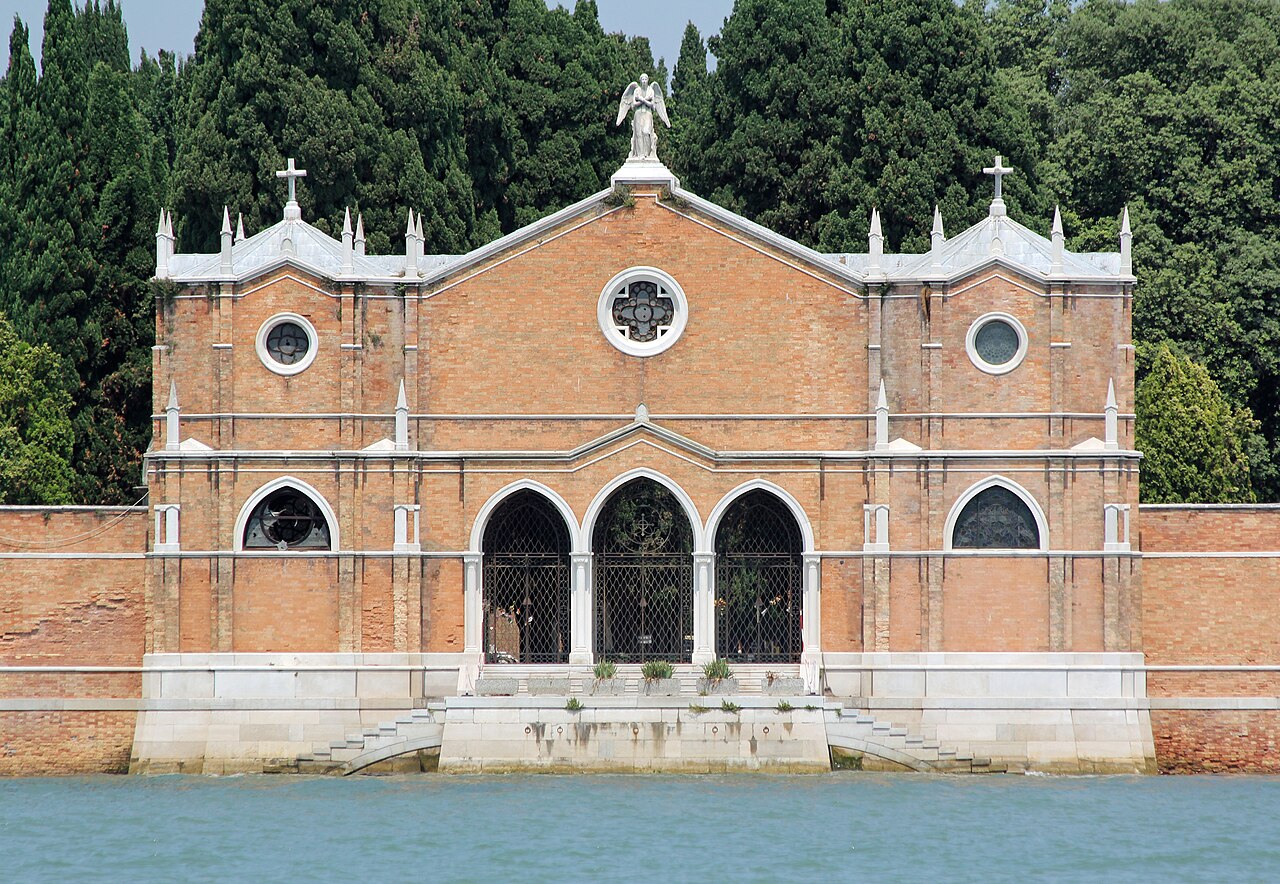
San Michele lies in the northern Venetian Lagoon, between Fondamente Nove and Murano. Visitors can recognise it from the water by its long perimeter of red brick, historic church, bell tower and lines of dark cypress trees.
Unlike Venice’s best-known islands, it is not primarily a place of shops, cafés or tourism. San Michele is an active municipal cemetery and a place where local families come to remember their relatives. That character should guide any visit.
Before the cemetery: the island of San Michele and its monastery
The island’s religious history goes back to a church dedicated to Saint Michael the Archangel in the tenth century. In 1212, the church was entrusted to the Camaldolese, a Benedictine monastic congregation. Their community developed the monastery and, over time, a notable library and spaces devoted to study.
The monastery was much more than a secluded religious house. Because the island was close to Venice’s trade routes, it also hosted distinguished visitors and ambassadors. The daily life of its residents connected prayer and scholarship with the knowledge carried by travellers through the lagoon.
Older accounts also recall the name Cavana de Muran, linked to the sheltering of boats associated with Murano—a reminder that navigation shaped even the island’s early identity.
Fra Mauro: the monk who mapped the world from San Michele
One of San Michele’s most extraordinary inhabitants was Fra Mauro, the fifteenth-century Camaldolese monk and cosmographer. Working in the monastery during the first half of the century, he brought together maps, written accounts and information shared by travellers and merchants.
He is celebrated for the Fra Mauro world map, produced around the middle of the fifteenth century. The work is an outstanding example of medieval and early Renaissance cartography, portraying the known world through an unusually broad combination of European, Asian and African geographical knowledge.
The map itself is not an object visitors should expect to see on the island today. The monastery’s importance lies in the fact that such ambitious intellectual work took shape within its walls. As the Museo Galileo research project explains, the monastery’s library and contact with ambassadors helped make it a remarkable centre of learning.
The Renaissance church of San Michele in Isola
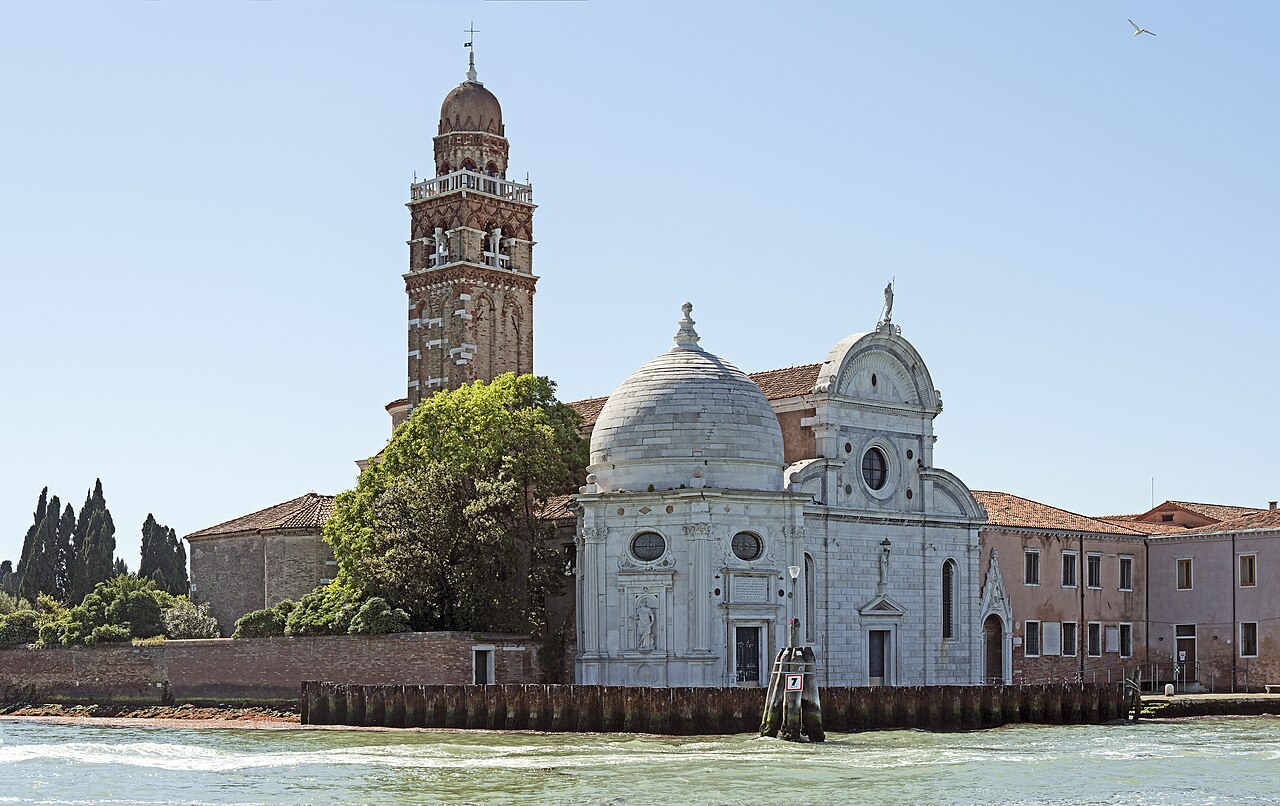
San Michele’s architectural legacy remains visible beside the cemetery. The church of San Michele in Isola, built between approximately 1468 and 1477 by Mauro Codussi and collaborators, is considered one of the first major Renaissance churches in Venice.
Its carefully proportioned stone façade contrasts with the surrounding brick buildings and the dark green of the trees. The bell tower dates to 1456, while the Emiliani Chapel was erected in 1527, according to the City of Venice’s historical record.
These buildings tell a different story from that of the tombs: they preserve the memory of a time when the island was a flourishing religious and intellectual community.
Why did Venice move burials to an island?
For centuries, many Venetians were buried in and around parish churches, in small graveyards distributed throughout the city. At the beginning of the nineteenth century, this arrangement began to change as governments introduced new public-health rules.
The decisive event was Napoleon’s 1804 Edict of Saint-Cloud, which promoted cemeteries outside densely inhabited areas. In 1807, Venice chose the island of San Cristoforo della Pace, immediately beside San Michele, as the site for its new general cemetery.
The existing monastery at San Cristoforo was removed to make room for graves, and architect Giannantonio Selva prepared the cemetery’s design. The new burial ground was completed in spring 1813, with burials beginning that year.
This distinction matters: the first modern cemetery was on San Cristoforo, not yet on the whole island known today as San Michele.
Two islands become one: the great transformation of 1835–1839
San Cristoforo’s new cemetery quickly proved too small. After the Camaldolese monastery on San Michele was suppressed under Napoleonic rule in 1810, the neighbouring island offered space for expansion.
Between 1835 and 1839, the canal separating San Cristoforo and San Michele was filled in. The former islands became a single, larger burial complex—the cemetery now commonly called San Michele.
This is one of the island’s most surprising facts. Its present shape is not entirely natural: Venice modified the lagoon to create enough land for a cemetery while preserving significant parts of the older religious architecture.
How San Michele became a monumental cemetery
As burial space continued to be developed, the city sought a unified architectural design. Several proposals were considered, but financial and technical difficulties delayed the work. A new competition was won by architect Annibale Forcellini; his design began to be implemented in 1870.
By 1876, San Michele had largely acquired its monumental nineteenth-century arrangement. Courts, paths, chapels, walls and planting created a carefully ordered landscape, inspired in part by the monumental cemetery tradition that was emerging in other Italian cities.
The island is therefore both a functioning cemetery and an architectural record of how Venice planned public spaces in the nineteenth century.
Famous graves: Stravinsky, Brodsky, Ezra Pound and Diaghilev
San Michele is often called an open-air museum because it contains important works of funerary art and the graves of writers, musicians, artists and public figures.
Among its internationally known burials are:
- Igor Stravinsky (1882–1971), the Russian-born composer associated with modern music and ballet.
- Sergei Diaghilev (1872–1929), founder of the Ballets Russes, buried in the Orthodox section.
- Ezra Pound (1885–1972), the American poet, buried beside the violinist Olga Rudge.
- Joseph Brodsky (1940–1996), the Russian-American poet and Nobel Prize winner, buried in Venice in 1997.
These names form only a small part of San Michele’s heritage. The cemetery also holds the stories of countless Venetian families and people whose lives shaped the city in less public ways. The City of Venice provides a map and lists of historically significant graves for those wishing to understand this heritage respectfully.
Cypress trees, burial sections and religious diversity
Behind the cemetery walls are tree-lined avenues, monuments and different burial enclosures. Catholic, Orthodox and Protestant traditions have left distinct traces in the cemetery’s history, reflecting Venice’s long-standing relationship with travellers, foreign communities and different faiths.
The landscape is striking not because it is picturesque, but because it remains a living place of memory. Historic monuments stand alongside areas in current use, reminding visitors that San Michele’s principal purpose has never disappeared.
A Venetian tradition: funerals arriving by boat
San Michele illustrates an aspect of Venice that makes even daily and ceremonial activities different from those of mainland cities: the cemetery can only be reached across water.
Historically, the deceased were transported aboard special funeral gondolas, some elaborately decorated. The City of Venice also records the occasional construction of a temporary floating bridge between Fondamente Nove and San Michele for the commemoration of the dead. This is not a permanent crossing or a service visitors should assume is available.
Even today, the water separating the cemetery from Venice gives the island a particular atmosphere, but it also requires careful planning for transport and access.
San Michele today: historic preservation and new architecture
The cemetery has continued to evolve. Following an international competition in the late 1990s, British architect David Chipperfield developed an expansion project, including the Court of the Four Evangelists, inaugurated in 2007, and further facilities.
In 2013, the Italian heritage authorities recognised the historical and artistic significance of the cemetery, monastery and church, bringing the complex under cultural protection.
San Michele is therefore not a monument frozen in the past: it is an active cemetery that must balance remembrance, maintenance, architecture and the conservation of its historic fabric.
Can you visit San Michele cemetery? Opening hours and rules
Yes, during the cemetery’s published opening hours. The municipal operator Veritas currently lists 7:30 a.m.–4:30 p.m. in winter and 7:30 a.m.–6:00 p.m. in summer; the change follows the switch between standard time and daylight saving time. Opening arrangements for certain holidays differ and some areas may be temporarily closed.
ACTV waterbus lines 4.1 and 4.2 serve the stop named Cimitero. Check the official Veritas cemetery information and current ACTV schedules before travelling.
Visitors must respect funeral services, people mourning relatives and cemetery regulations. The City of Venice states that organised cultural visits require prior authorisation; photography and filming are subject to municipal rules. Veritas and the municipal office do not provide cultural tour guides at the cemetery.
Discovering the quieter side of Venice from the lagoon
Seen from the boat, the cemetery walls, church and cypresses create one of the most recognisable profiles in the northern lagoon. San Michele also connects naturally with stories of other islands, from the monastic history of San Lazzaro degli Armeni to the changing cultural life of San Servolo.
If you would like to explore the lagoon through a personalised private boat itinerary, discover our island experiences or contact us. Routes can be discussed according to your interests and navigation conditions; viewing San Michele from the water does not imply a cemetery visit or special access.
Find more stories in our collection, History of the Venetian Lagoon Islands.
Frequently asked questions
Why is San Michele an island cemetery?
Following nineteenth-century sanitary reforms, Venice established a cemetery on San Cristoforo in 1813, then expanded it onto neighbouring San Michele. The canal between them was filled between 1835 and 1839.
What was San Michele before it became a cemetery?
It was home to a Camaldolese monastery from 1212, an important library, the Renaissance church of San Michele in Isola and the cartographer Fra Mauro.
Who is buried at San Michele?
Alongside generations of Venetian residents, notable figures buried here include Igor Stravinsky, Sergei Diaghilev, Ezra Pound and Joseph Brodsky.
How do you get to San Michele and is it open to visitors?
ACTV lines 4.1 and 4.2 stop at Cimitero. The cemetery is generally open daily, with seasonal hours posted by Veritas; visitors must respect its rules and its continuing function as a burial ground.
Sources and photo credits
Historical, practical and visitor information: City of Venice – San Michele Cemetery; Veritas – cemetery opening information; Museo Galileo – Fra Mauro and the monastery. Featured photograph: Kasa Fue, San Michele (2020), Wikimedia Commons, CC BY-SA 4.0, resized to 1280 px. Other photographs credited in the captions.