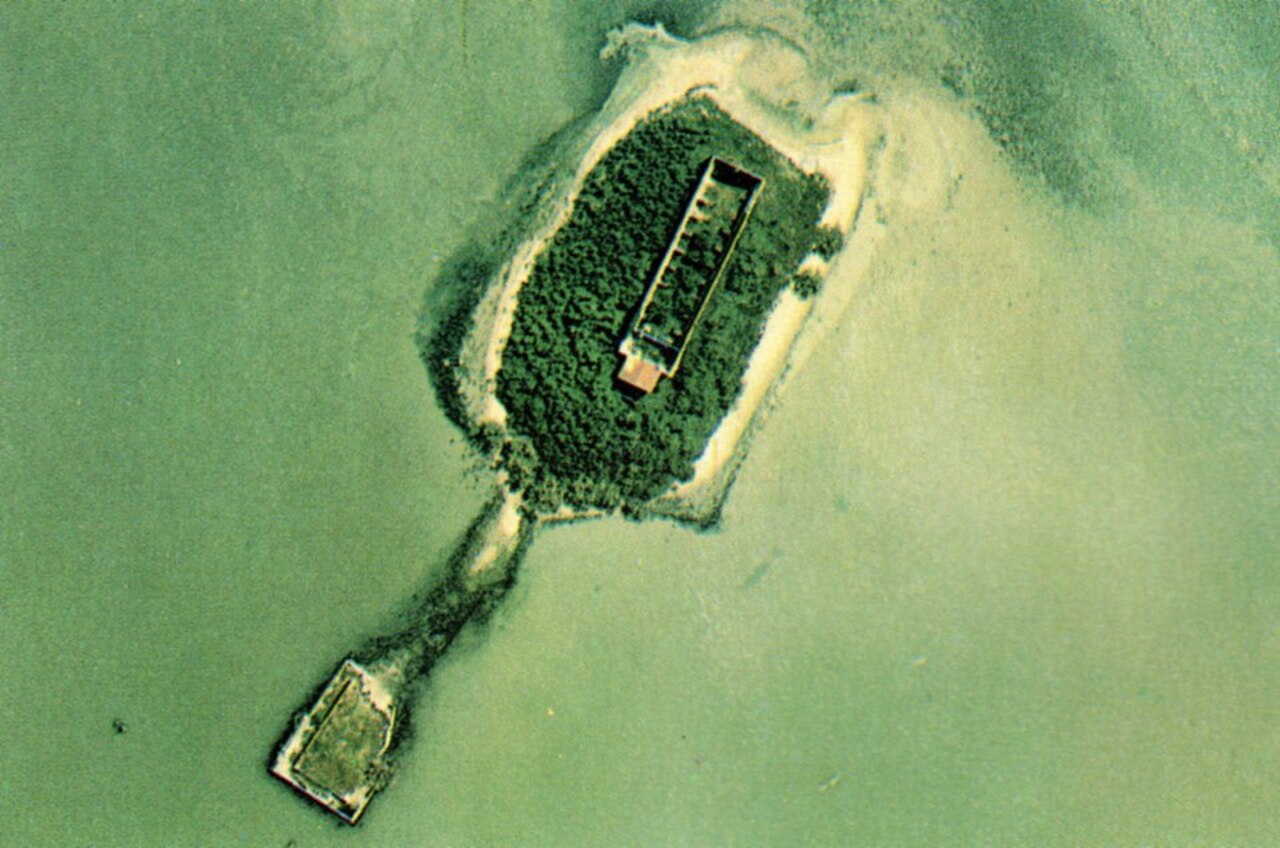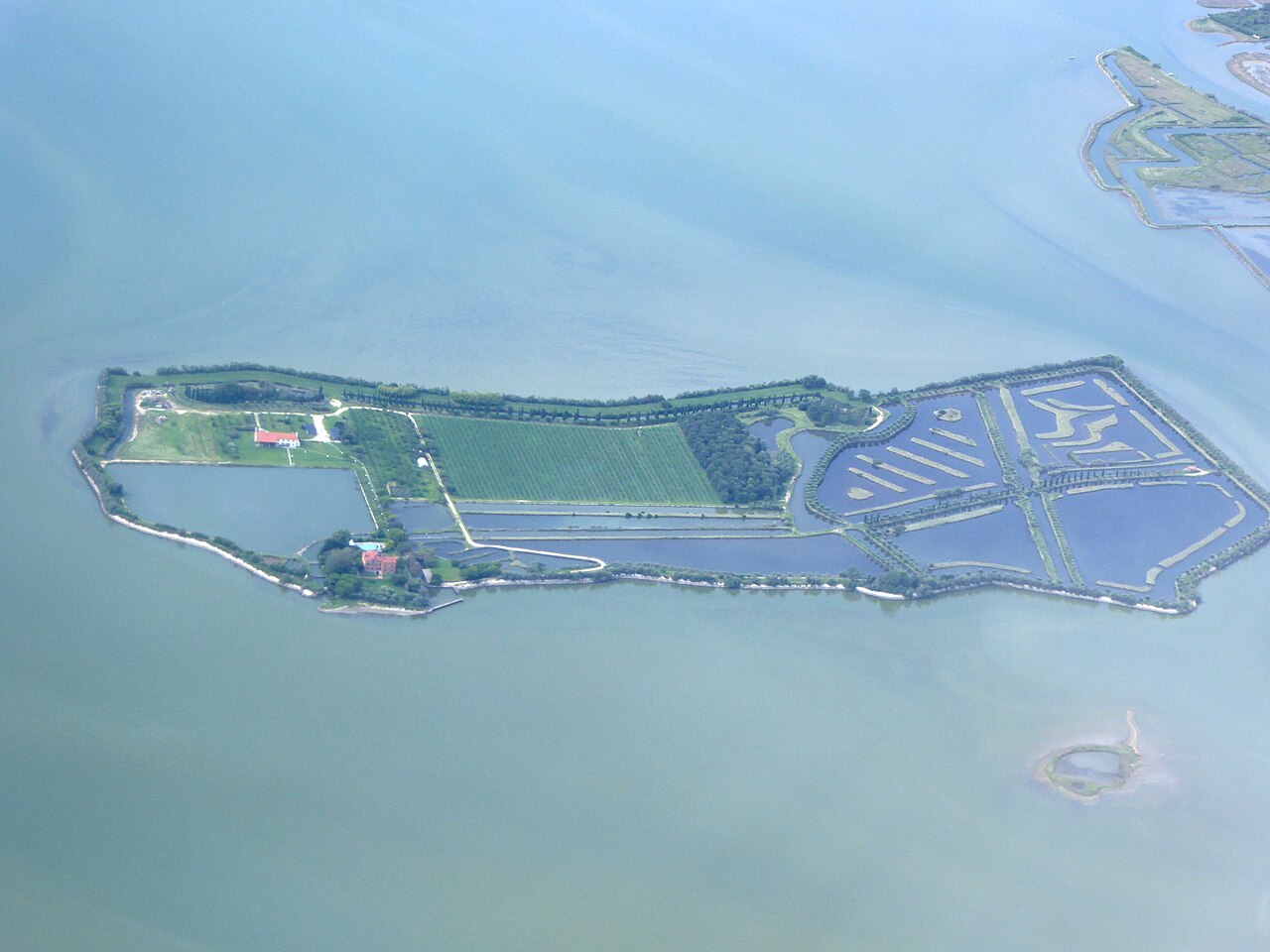
At the entrance to the Venetian Lagoon, a monumental Renaissance fortress was built to protect Venice from enemy ships approaching from the Adriatic. It is Fort Sant’Andrea, on the island of Sant’Andrea near Le Vignole: a place where the story of the Republic can be read in stone walls, cannon openings and a waterfront designed to impress visitors as much as to stop invaders.
The history of Sant’Andrea island in Venice extends from medieval defensive towers to Michele Sanmicheli’s sixteenth-century architecture, an encounter with Giacomo Casanova, the dramatic confrontation with a French vessel in 1797 and a new cultural restoration project announced at the end of 2025.
Where is Sant’Andrea island in the Venetian Lagoon?
Sant’Andrea is a small fortified island near Le Vignole, on the northern side of the waterways leading towards the Lido inlet. From this strategic position, the defenders could monitor boats entering the lagoon from the Adriatic and sailing towards Venice’s historic centre.
The fortress sits within a network of lagoon islands, sandbanks, canals and navigable passages. Unlike Venice’s central districts, Sant’Andrea was never primarily a residential or commercial neighbourhood. Its main purpose was military defence and control of maritime access.
Do not confuse the island with San Giorgio Maggiore, home to Palladio’s famous Basilica, or San Giorgio in Alga, an abandoned former religious island. Sant’Andrea belongs to an entirely different story: the development of Venice’s fortifications.
Why did Venice need a fortress at the Lido inlet?
The lagoon itself was a natural defence. Large enemy vessels could not simply sail anywhere they wished: waterways were shallow, channels were winding, and knowledge of tides and sandbanks was crucial. Nevertheless, Venice had to protect the port entrances that connected the city with the Adriatic.
For centuries, the entrance near San Nicolò del Lido was particularly important. From the sea it led towards the lagoon channels and the political and commercial heart of the Venetian Republic. A hostile fleet reaching this passage would be a serious threat.
Rather than building walls around the entire city, Venice developed a system of strategically positioned forts and batteries. Sant’Andrea became one of its most visible and technically ambitious strongholds.
The medieval Castel Nuovo and the two castles of the inlet
Before the Renaissance fortress, the island was already fortified. Historical and architectural studies describe a medieval defensive site called Castel Nuovo on Sant’Andrea and its counterpart Castel Vecchio on the opposite shore at San Nicolò.
The two positions were sometimes known as the Do Castelli or “two castles”. They controlled the narrow maritime passage from opposite sides and formed an early system of surveillance and defence.
The medieval tower on Sant’Andrea was not entirely demolished when the newer fortress was built. Its masonry became part of the later monumental complex, preserving an unusually visible link between two generations of Venetian military architecture.
Chains, floating platforms and the closing of the waterway
The defensive system did not rely only on stone towers. Historical descriptions mention a chain barrier stretched between Sant’Andrea and San Nicolò, supported by floating structures that could help restrict passage through the inlet.
These floating barriers and armed rafts are documented in studies of Venice’s coastal defences. Their purpose was to obstruct unwanted vessels and support the artillery deployed on the shores.
They also illustrate a distinctively Venetian approach to military planning: water itself became part of the fortress. Controlling channels was as important as defending walls.
The sixteenth century: a new threat and new artillery
By the sixteenth century, developments in naval artillery had made many medieval defensive structures inadequate. The growing power of cannon required thicker walls, lower firing positions and designs capable of covering broad areas of water with overlapping fields of fire.
At the same time, the Republic had to respond to shifting political and military pressures across the Mediterranean, including conflict with the Ottoman Empire. Fortresses were important not only because a direct attack might occur, but because they visibly demonstrated Venice’s ability to protect its ports.
In 1542 the Republic established the Provveditori alle Fortezze, officials responsible for the maintenance and development of its fortified places. Sant’Andrea became part of this broader modernisation.
Michele Sanmicheli: the architect of Fort Sant’Andrea
The architect Michele Sanmicheli (1484–1559), born in Verona, was one of the most important designers of military architecture in the Venetian territories. His experience included work on fortifications that had to reconcile the demands of artillery with the political prestige of the Republic.
On 12 September 1543, according to historical research, the Council of Ten approved his project for the rebuilding of the fortress on Sant’Andrea. The work integrated earlier defensive structures and created a new frontage of remarkable scale.
The result was a Renaissance fort designed as both a functioning artillery platform and a ceremonial statement of Venetian strength to sailors approaching the city.
1543–1549: construction of the great Renaissance fortress
The main body of the new fort was constructed between 1543 and 1549. The builders used massive stone and brick walls, broad curtains and gun positions facing the inlet. Further strengthening and adaptations followed, particularly during 1570–1571 amid renewed military fears.
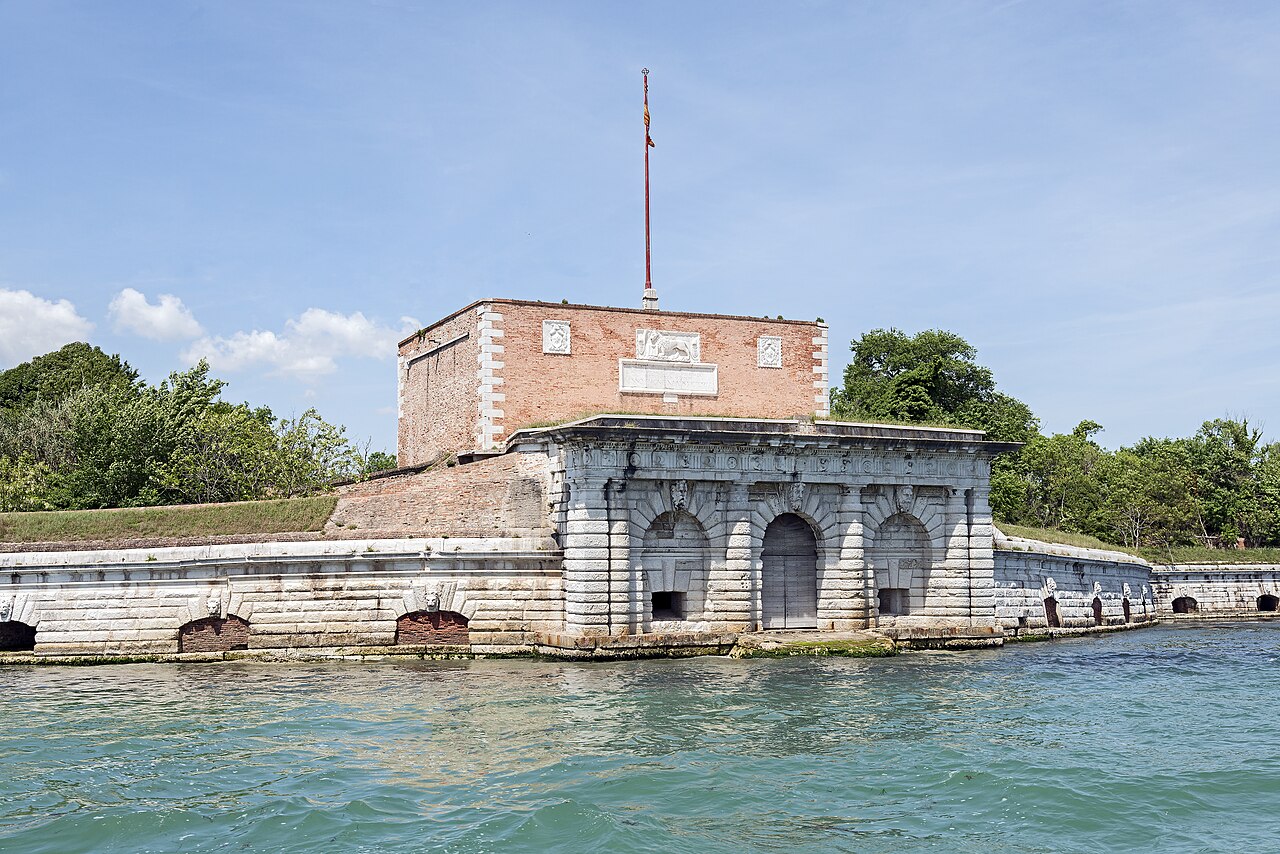
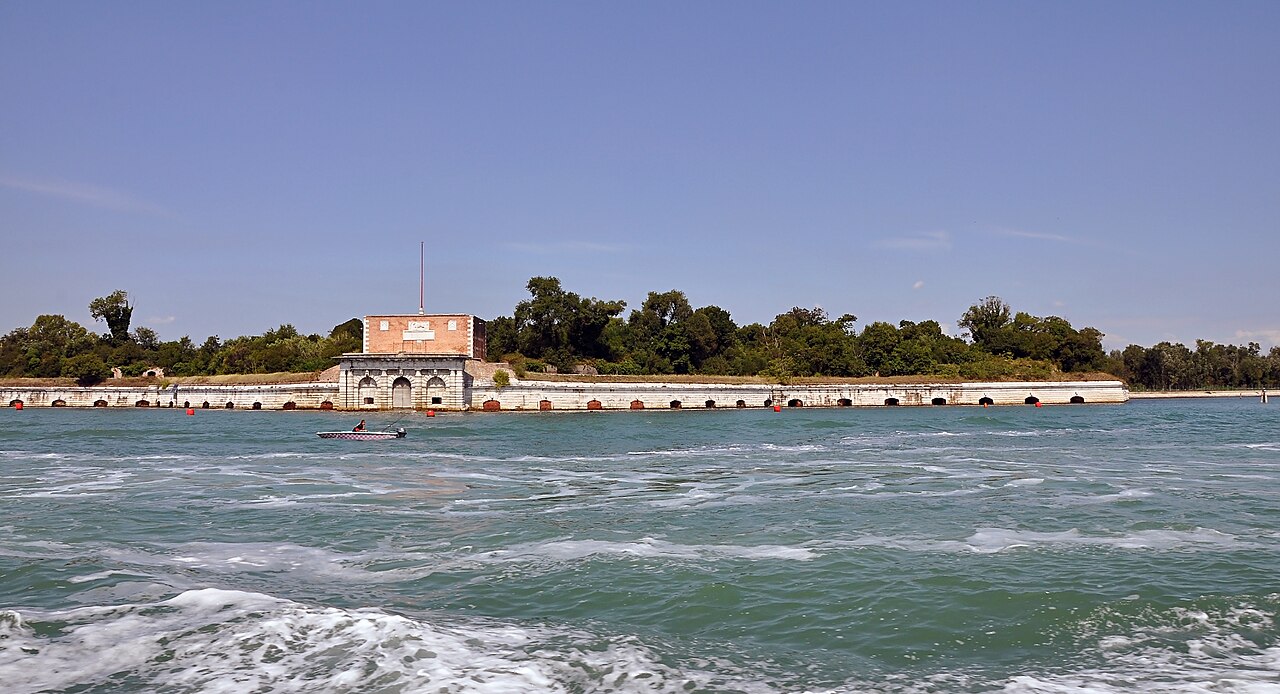
A document from the Veneto Region describes the main front as extending for more than 300 metres, with the central block approximately 16.5 metres high and the lower bastions about 7.5 metres high.
The fortress combined solidity with visual order. Its long horizontal profile appears almost to grow out of the lagoon, while the imposing central entrance recalls the monumental architecture of Renaissance civic buildings.
The monumental entrance and the lion of Saint Mark
The fort’s best-known architectural feature is its monumental three-arched entrance, facing the water and framed in pale stone. Above it stands the older central tower, or mastio, with sculpted and inscribed elements recalling the Republic’s identity.
The lion of Saint Mark, the symbol of Venice, communicated state authority to ships arriving at the lagoon. The fortress was effectively a stone announcement: the port was controlled by the Serenissima.
A commemorative inscription associated with the victory at the Battle of Lepanto in 1571 was placed on the tower. These symbols reveal how military buildings could also convey diplomatic messages to foreign visitors and ambassadors.
Water-level gun openings and the art of deterrence
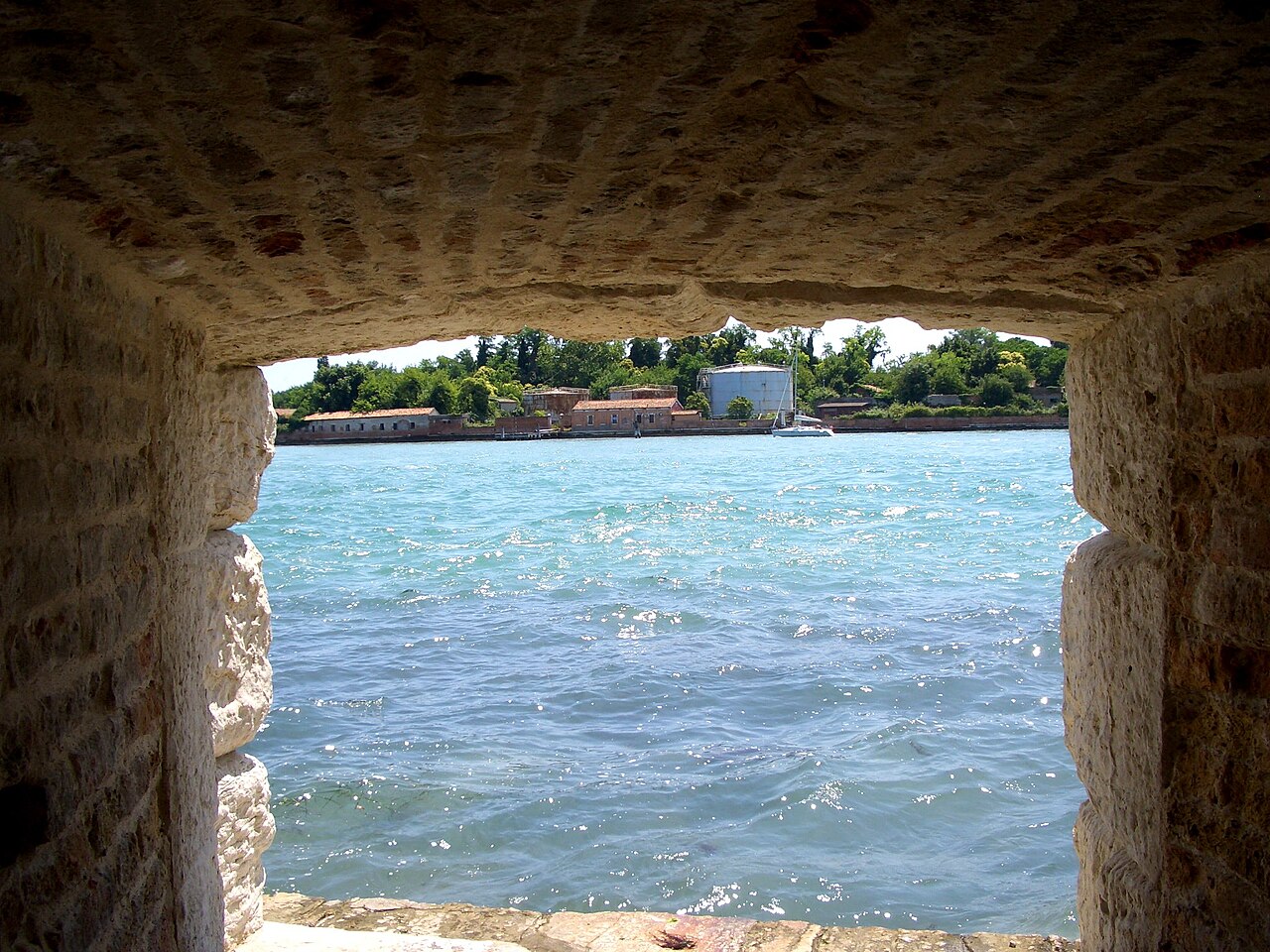
One of the most innovative aspects of Sant’Andrea was the positioning of its cannon openings close to water level. Artillery could aim across the approach channel and threaten the hulls of vessels attempting to enter without permission.
Accounts describe approximately forty vaulted artillery positions, arranged to cover an exceptionally wide sector of the waterway. The central tower, the casemates and the curving external walls formed a unified defensive system.
In practice, the fortress was also a form of deterrence. The sight of numerous cannon ports was intended to persuade enemies that forcing the entrance would be extremely costly, even when no battle actually took place.
How Sant’Andrea worked with San Nicolò and the lagoon forts
Sant’Andrea was part of a larger defensive network. Across the channel stood San Nicolò del Lido; farther south, other fortifications guarded the entrances near Malamocco and Chioggia.
The Republic also developed defensive octagonal batteries, often called ottagoni, as well as forts at Alberoni, San Pietro in Volta, San Felice and other strategic points.
This system was designed around the lagoon’s geography rather than a continuous line of land fortifications. Each structure guarded a passage or supported another position, allowing Venice to make the most of its shallow waters.
For a different island once linked to military activities, discover the history of La Certosa.
1743: Giacomo Casanova’s confinement at the fortress
The fortress also appears in the life of Giacomo Casanova. In his memoirs, the famous Venetian writer and adventurer describes a period of confinement at Sant’Andrea between approximately March and July 1743, when he was still young.
Although the stronghold was not primarily built as a prison, a remote military station could serve as a place of supervised residence for people whom the authorities wanted to keep under control.
Casanova’s account offers a rare personal glimpse of life within an otherwise formal military institution. It adds a human dimension to the history of a building usually discussed in terms of engineering and artillery.
20 April 1797: the French vessel Libérateur d’Italie
For most of its history, the great fortress did not need to fight a major naval battle. Its best-known armed encounter came on 20 April 1797, just weeks before the collapse of the Venetian Republic.
The French vessel Le Libérateur d’Italie, commanded by Jean-Baptiste Laugier, attempted to enter the Lido inlet with other vessels. Venetian defenders under Domenico Pizzamano ordered the ships to stop; a confrontation followed in which the French captain was killed and the vessel was taken.
The sequence of warning shots, artillery fire and intervention by Venetian boats has been reconstructed from contemporary reports. Later accounts sometimes simplify the incident into a single cannon shot from the fort, but it involved a more complex encounter at the entrance to the lagoon.
The episode increased tensions at a moment when the Republic was already under enormous political pressure. Venice’s government fell on 12 May 1797. The incident at Sant’Andrea was dramatic, but it should not be presented as the sole cause of the Republic’s collapse.
After 1797: military changes under new governments
With the end of the Serenissima, Venice passed through periods of French and Austrian control before becoming part of the Kingdom of Italy in 1866. Sant’Andrea remained associated with military functions, although technology and naval tactics changed considerably.
The growing range and power of modern guns reduced the strategic importance of a sixteenth-century gun platform close to the water. Military authorities adapted some spaces while other areas began to deteriorate.
The former fortress and adjoining island remained part of a wider militarised lagoon whose use also included barracks, depots and defensive installations on other islands.
The twentieth century: military aviation near Sant’Andrea
During the early twentieth century, Sant’Andrea and nearby waterways were connected with the development of naval aviation. The Veneto Region’s Great War heritage register documents a seaplane base associated with the San Marco squadron.
During the First World War, aircraft operating from this area undertook reconnaissance and defence missions over the northern Adriatic. Later equipment included the Italian Macchi M.5 flying boat.
This is a lesser-known part of the island’s history. It shows how a site originally designed for cannon-armed ships was drawn into a completely new form of maritime warfare.
Military abandonment and the deterioration of the fort
As its military importance declined, parts of the complex were used less intensively and eventually fell into disrepair. Vegetation grew around the old structures, while moisture, salt and the movement of lagoon soil continued to threaten the masonry.
Over time, restoration and foundation-consolidation works were carried out to limit further damage. The Italian Ministry of Culture nevertheless lists the property among important heritage sites requiring renewed care and conservation.
Sant’Andrea therefore became an especially visible example of the wider challenge facing Venice: how to preserve historic islands whose original military or institutional functions have disappeared.
2023: research and renewed public interest
In April 2023, researchers involved in the Venice’s Nissology (VeNiss) project carried out an advanced digital survey of the fort using technologies including laser scanning and drones. The work aimed to document its architecture and connect the physical remains with historical records.
The resulting research highlights the importance of studying the fortress as part of the broader evolution of Venice’s islands, rather than as an isolated architectural monument.
Public associations and cultural groups have also repeatedly called for Sant’Andrea to be protected and made accessible. Their efforts raised questions about the possible sale of the site, long-term stewardship and a form of reuse compatible with the fragile lagoon environment.
December 2025: the deboleFORTE regeneration project
On 23 December 2025, the Italian Agenzia del Demanio announced the winner of the international Reinventing Cities competition for Sant’Andrea: the project deboleFORTE, proposed by the cultural association MicroClima and an interdisciplinary team.
The announced plan provides for a future 30-year concession and approximately €8 million in investment. Rather than converting the fortress into a conventional hotel, it proposes a public-oriented centre for culture, environmental research, arts, community participation and sustainability.
The project’s aim is to restore the buildings and gradually open the island to public use. However, the selection of a project is not equivalent to a completed restoration or an immediate opening. Access conditions will depend on safety works, official permissions and the programme implemented by the managing organisations.
The project can be followed through the official Forte Sant’Andrea project website and the Agenzia del Demanio announcement.
Can you visit Fort Sant’Andrea in 2026?
As of November 2026, Fort Sant’Andrea should not be treated as an ordinary attraction with guaranteed daily public access. Its restoration and future public use are the subject of a specific regeneration project. Special visits, cultural initiatives or authorised access may take place under separate arrangements, but they are not proof that the entire fort is freely open.
There is no reason to assume that a normal public waterbus stop provides direct visitor entry to the historic complex. The safest option is to verify the current situation directly with the project organisers or the responsible public authority before planning a landing.
A private boat tour may allow the fortress to be viewed from navigable lagoon waters, subject to traffic rules, safe navigation and weather. Landing on the island or entering the fort must not be promised without explicit authorisation.
Discover Sant’Andrea and Venice’s defensive islands by boat
From the water, Sant’Andrea’s architectural purpose becomes especially clear: the monumental stone portal faces incoming vessels, while the long low gun batteries follow the channel. The position also explains how the island fits into the wider defensive system near Le Vignole, Sant’Erasmo and the islands surrounding Venice.
Discover the historical landscapes of the lagoon through our Riding the Lagoon boat tour or contact us to discuss a private custom itinerary. Any viewing route or potential landing must be agreed according to navigation conditions and actual access permissions.
Continue with the other articles in History of the Venetian Lagoon Islands.
Frequently asked questions
Who designed the Forte Sant’Andrea in Venice?
The sixteenth-century fortress was designed by Michele Sanmicheli, the Renaissance architect from Verona. Construction of the main structure took place between 1543 and 1549, with later works.
Why was Fort Sant’Andrea built?
It was built to control the Lido inlet and deter enemy ships from entering the Venetian Lagoon. The low cannon openings were designed to cover the approach channel with artillery fire.
What happened at Fort Sant’Andrea in 1797?
On 20 April 1797, Venetian defenders confronted the French ship Le Libérateur d’Italie at the inlet. Its captain was killed, and the incident occurred shortly before the fall of the Republic in May.
Is Forte Sant’Andrea open to tourists?
The fortress is the subject of a restoration and public-access project announced in December 2025. General daily access should not be assumed; viewing from a private boat is different from having permission to land or enter.
Historical sources and photographic credits
Sources: Veneto Region – fortress history and dimensions; Italian Ministry of Culture – historic fort and conservation; University of Florence – historical and 3D survey of the fort; Veneto Great War – seaplane base; Agenzia del Demanio – December 2025 regeneration announcement; deboleFORTE / Sant’Andrea project. Featured photo: Didier Descouens / Wikimedia Commons, CC BY-SA 4.0, resized to 1280 px. Internal photos are credited in their captions.