
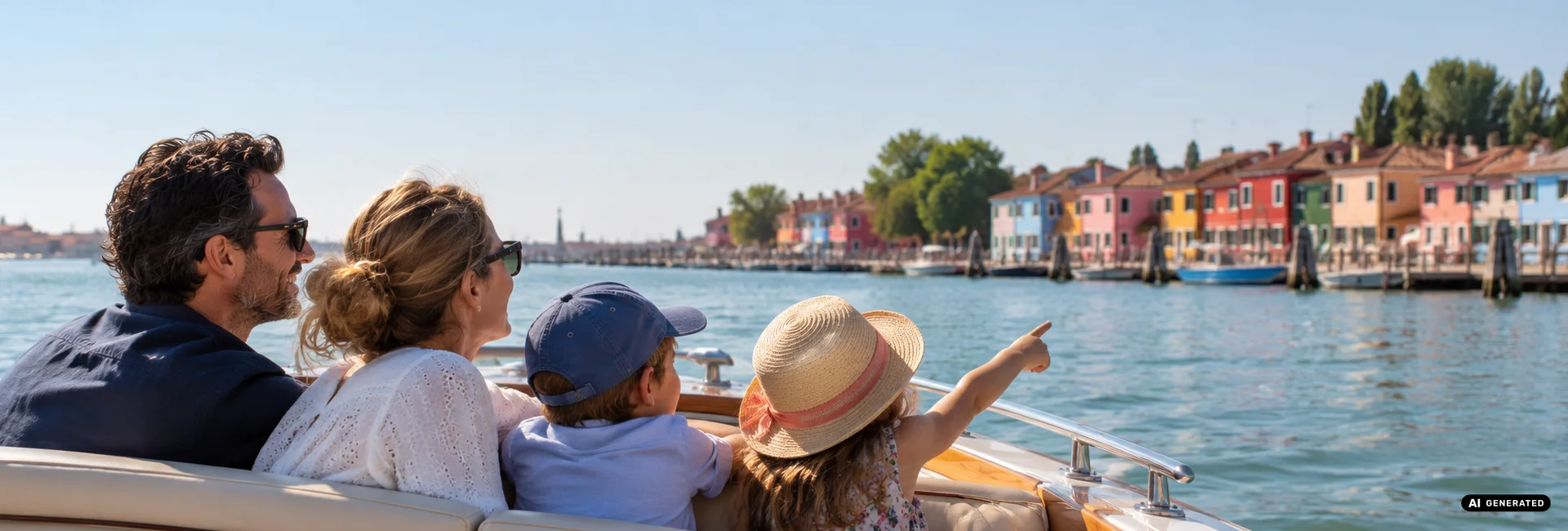
Murano and Burano with children: two very different islands
Murano and Burano with kids can work especially well because the islands offer different kinds of stimulation. Murano is connected with fire, craft and glassmaking; Burano is immediate, colourful and easy to read visually. A private boat lets the family decide how much time each place deserves instead of following the same schedule as every other group.
Why Murano can engage children
Murano becomes more interesting when the visit includes something active or visible. The official Glass Museum describes family programmes with real samples, activity materials and, in some cases, a visit to a working furnace. The recommended ages vary by activity, generally around 6 to 14. For younger children, a short demonstration may be enough; for older children, the history of techniques, trade secrets and glass beads can make the island much more memorable.
What families should know about glass demonstrations
Glassworking is fascinating but also involves heat and safety restrictions. Hands-on glassmaking is not automatically appropriate for young children, so activities should be checked in advance. The useful principle is simple: do not overbook Murano. One good demonstration or museum activity is often better than several similar stops.
Why Burano works differently
Burano offers a change of pace. Its painted houses, compact streets and water edges make it visually engaging without requiring a long explanation. Families can walk, take photographs, stop for a snack and explore at a relaxed pace. The Lace Museum also offers family activities: one programme for children aged 6 to 12 uses knots and weaving to explain how lace is built and includes an independent discovery route around the island.
How much time to spend on each island
There is no ideal formula. A family with children interested in crafts may want more time on Murano. Another family may prefer a quick glass demonstration and a longer lunch or walk on Burano. Private planning matters because energy levels change during the day, especially in summer heat or after a busy morning in Venice.
Add Torcello or keep the day simple?
Torcello can add space, archaeology and a quieter atmosphere, but it is not always necessary. With younger children, two islands may already be enough. With older children or a full-day boat plan, Torcello can provide a useful contrast to Murano and Burano. The decision should depend on attention span and total time rather than on trying to complete a list.
Family logistics by private boat
A private route avoids the need to organise the entire day around public-transport connections. You still need realistic navigation time, and restaurants or museum activities should be reserved when necessary, but the sequence can be built around your family rather than around a large-group departure schedule.
Official museum information
Current family activities can be checked directly with the Murano Glass Museum and the Burano Lace Museum.
How to plan a balanced family day
For families, the sequence matters as much as the destination. A morning craft activity can be followed by a relaxed lunch, while a hot summer afternoon may be better used for a shorter walk and more time on the water. Museum and furnace opening times should be checked before departure, and a private route should leave enough margin for children to stop when something unexpectedly catches their attention. This is one of the advantages of not treating the islands as a checklist.
When Murano is the priority, the route should still leave enough time for breaks and unplanned discoveries. Good Murano planning compares navigation time with the attention span of the youngest traveller. Murano works better when one strong activity is protected instead of filling every available hour. Season and weather can change how Murano should be organised, especially in summer heat or windy conditions. Parents should tell us which part of Murano matters most before we suggest additional stops. A private format makes Murano easier to adapt when the family needs a slower or faster rhythm. Food reservations and museum times should support Murano rather than force the entire day into a rigid schedule.
Frequently Asked Questions
Are Murano and Burano suitable for younger children?
Yes, but keep the day simple. Short demonstrations, colour, boat time and breaks often work better than a dense museum schedule.
Can we visit a glass furnace with children?
Often yes, but age limits, safety rules and availability vary. The visit should be arranged in advance.
Should we add Torcello?
It can be a good addition for older children or a longer day, but two islands may be more enjoyable for younger children.