Nature is one of the most surprising ways to understand the lagoon
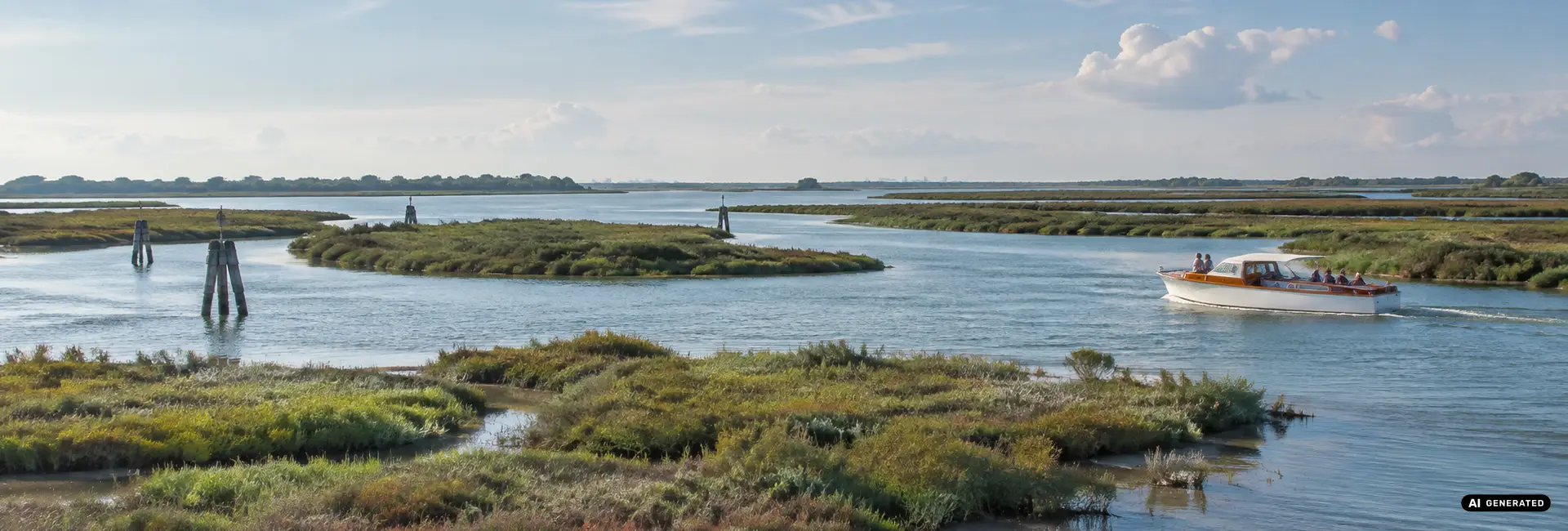
Nature around Venice is not a decorative backdrop. The lagoon is a living system of shallow water, salt marshes, islands, channels, dunes and coastal habitats. A private boat can reveal how quickly the landscape changes once you move away from the historic centre.
The experience should be observational rather than invasive. Protected areas have conservation rules, sensitive habitats and seasonal wildlife, so the route must respect access conditions and the places where visitors should remain at a distance.
Northern lagoon: gardens, reeds and quieter islands
Sant’Erasmo is the largest island of the northern lagoon and is known for vineyards, vegetable plots and open green space. Nearby Certosa has a public park with poplar woods, ash trees, clearings and reed beds, creating a green transition between Venice and the wider lagoon.
Further north, sandbanks and less urbanised areas can provide opportunities to observe birdlife and the geometry of channels and barene. The exact route depends on navigation conditions and on whether the priority is landscape, photography or a slower island visit.
Southern lagoon: Alberoni, Pellestrina and Ca’ Roman
At the southern end of the Lido, Alberoni is part of the Natura 2000 site “Lido di Venezia: biotopi litoranei”. The Comune di Venezia describes one of the best-preserved dune systems of the Upper Adriatic, with beach, dunes, wetlands and pine woodland.
Ca’ Roman, at the southern end of Pellestrina, preserves another important mosaic of beach, dunes, wet depressions, woodland and lagoon habitats. These are places to approach with respect: the value of the experience comes from understanding the ecosystem, not from treating protected areas as entertainment spaces.
Poveglia and the landscape of the southern lagoon
Poveglia can be an evocative visual presence in the southern lagoon because of its vegetation, history and isolated profile. We can consider routes around the island when appropriate, but access should never be assumed: permissions, safety and operating conditions determine what is actually possible.
A nature-focused day can also combine landscape photography, birdwatching interests and a stop on an inhabited island. Longer durations make it easier to connect different habitats without rushing from north to south.
For a specific existing itinerary, see our Nature Tour in the Venetian Lagoon.
For authoritative information on protected coastal habitats, see the Comune di Venezia Natura 2000 areas.
Read the lagoon as a living landscape
A nature experience is strongest when the route shows how different lagoon environments connect. A nature itinerary can move from cultivated islands to barene, open water and protected coastal areas. A nature day around Certosa, Sant’Erasmo or the southern lagoon can reveal very different landscapes. A nature route should favour observation rather than speed.
A nature experience near Alberoni or Ca’ Roman can focus on dunes, coastal vegetation and birdlife, while a nature route in the north can emphasise agricultural islands and salt-marsh scenery. A nature day may include Poveglia as a historical and landscape reference without assuming that landing is possible. A nature itinerary should distinguish what can be observed from the water from what can be visited on land. A nature plan also needs to respect sensitive areas and seasonal restrictions.
For travellers interested in nature, slower navigation often reveals more than a long list of destinations. A nature route can change with season, tides and bird movements. A nature experience should never promise a specific sighting, but it can choose areas that make sense for the date. A nature day is about understanding the lagoon rather than simply passing through it.
Slow navigation makes the landscape easier to read
The most interesting environmental routes are not necessarily the longest. Moving between a cultivated island, a stretch of salt marsh and a protected coastal area can reveal more than trying to cross the entire lagoon. The transitions show how freshwater influence, tides, wind, sediment and human settlement interact in a territory that is constantly changing.
Visitors should also distinguish between observing a place from the water and entering it. Some sites have public paths, others have restricted or sensitive sectors, and conditions can change. We plan the boat route first around safe navigation and respect for the environment, then discuss any possible landing or walk separately when it is appropriate and permitted.
Season also changes what you may observe. Migration periods, nesting, vegetation and water conditions do not follow a tourist timetable. We therefore avoid promising a particular species or a fixed natural spectacle. Tell us what interests you most and we can choose an area that makes sense for the date, while keeping a respectful distance from wildlife and following any local restrictions. This approach usually creates a richer experience than chasing a checklist of sightings.
Frequently Asked Questions
Can we visit protected natural areas?
Some areas are publicly accessible, but routes and behaviour must respect conservation rules, local access conditions and seasonal restrictions.
Is Poveglia always accessible?
No. We do not promise access to Poveglia; any route must respect permissions, safety and current operating conditions.
Is this suitable for birdwatching and landscape photography?
Yes, especially when the route is planned around observation and light rather than trying to include too many stops.