Hidden Islands of the Venetian Lagoon is designed for travellers who want a private experience shaped around the Venetian Lagoon rather than a fixed checklist. The route, time ashore and navigation should always reflect real conditions, personal interests and the character of the places visited.
A lagoon shaped by many different uses
The hidden islands of the Venetian Lagoon reveal a geography that is much richer than the familiar Murano and Burano circuit. Some places preserve religious history, others tell stories of quarantine, institutions, agriculture or changing uses over centuries.
San Francesco del Deserto and spiritual retreat
San Francesco del Deserto is among the islands associated with silence and Franciscan life. Access is specific and should never be assumed, but its presence helps explain the spiritual dimension of the northern lagoon.
Lazzaretto Nuovo and maritime quarantine
Lazzaretto Nuovo belongs to the history of Venice’s quarantine system. Archaeology and public visits make it an important reference when discussing islands shaped by health controls and maritime movement.
San Servolo and San Clemente show changing functions
San Servolo and San Clemente show other layers of island history closer to central Venice. Their present uses differ, reminding visitors that lagoon islands continually change function rather than remaining frozen in the past.
Some places are best understood from the water
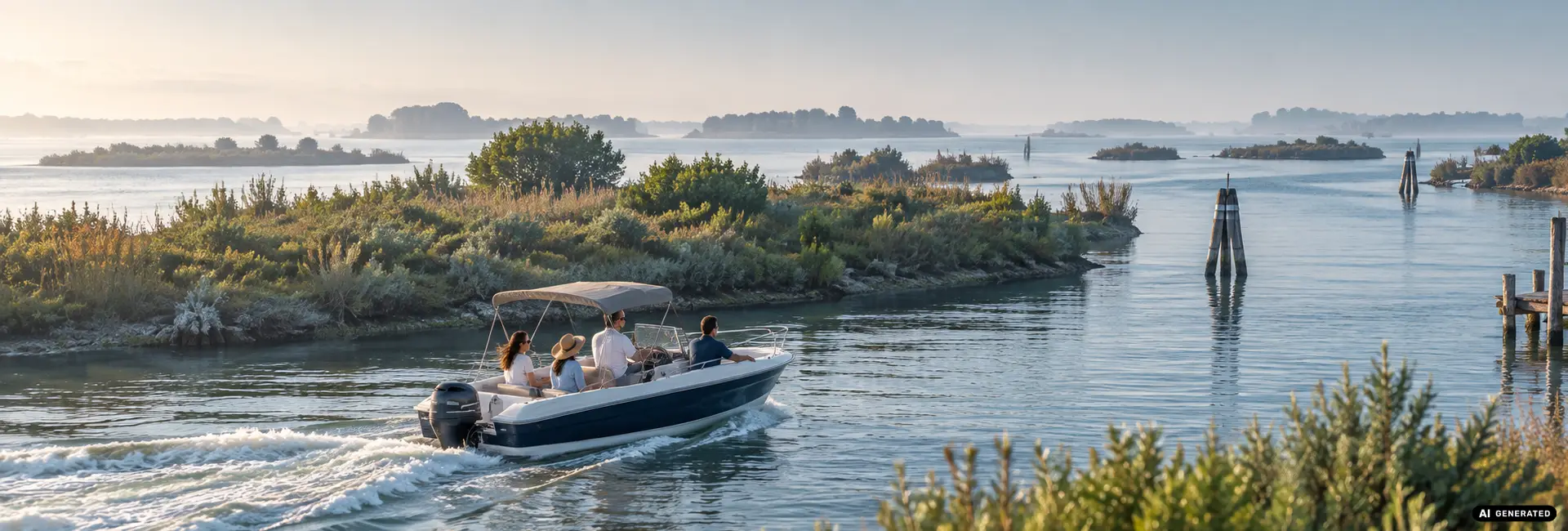
Other small islands may be visible during navigation even when landing is not possible. The relationship between islands, barene and channels is often more interesting than treating every place as an attraction that must be entered.
Access determines what a route can promise
A private route among hidden islands therefore starts with access and realistic navigation. Some islands are private, protected, seasonally accessible or subject to specific visiting arrangements.
Place lesser-known sites within the wider lagoon
Our Venetian Lagoon by private boat overview helps place these lesser-known places within the wider geography and connect them with more familiar destinations.
Check current visitor information
For general visitor information and official destination context, consult Venezia Unica. Access to individual islands should always be verified from current authoritative information.
Photography does not always require landing
Photography can be a strong reason to explore hidden islands because distance, vegetation and low profiles create a different visual experience from monumental Venice. The route should still respect protected areas and navigation limits.
Choose a theme before choosing names
Tell us whether history, nature, photography or quiet navigation is the priority. We can discuss which islands make sense for the available time without promising access where it cannot be guaranteed.
Hidden does not mean freely accessible
The fascination of lesser-known places often comes from seeing how many different functions the lagoon has supported. Religious communities, quarantine stations, hospitals, military uses and modern hospitality have all occupied islands that many visitors pass without recognising from the water.
Access is the key distinction when discussing hidden places. Some places welcome visitors at defined times, some are private, and others are best understood from the boat. A responsible itinerary should never imply that every landing is possible. The status of individual destinations must be checked before the day is presented as a finished route.
San Francesco del Deserto and Lazzaretto Nuovo illustrate two very different stories: spiritual retreat and maritime quarantine. Other islands closer to Venice reveal medical, institutional or contemporary uses. Choosing hidden islands by theme produces a more coherent experience than trying to collect unfamiliar names.
Photography is often rewarding even without landing. Low profiles, vegetation, abandoned structures and broad water can give these islands a strong visual presence from a respectful distance. Tell us whether the interest is history, solitude, architecture or landscape, and we can identify which islands make sense together.
A lesser-known route can also be combined with one familiar destination, creating context rather than isolation. Seeing a working or inhabited place before approaching a quieter site helps explain how different functions coexist across the lagoon. The strongest itinerary is therefore not necessarily the one with the most obscure names, but the one in which each stop adds a new layer to the story.
Frequently Asked Questions
Can every lesser-known island be visited?
No. Access varies: some places have scheduled visits, some are private and others may only be appreciated from the water.
Which stories can a hidden-island route explore?
Religious life, quarantine, medicine, military history and changing modern uses are all part of the wider lagoon story.
Do we need to land on every stop?
No. Seeing a site from the water can be meaningful when access is restricted or when the landscape itself is the main interest.